




Based in Varanasi since 1997, BABA Advertisers is a leading advertising agency in Varanasi, India, with a rich legacy of driving remarkable sales for our clients through comprehensive digital advertising services.

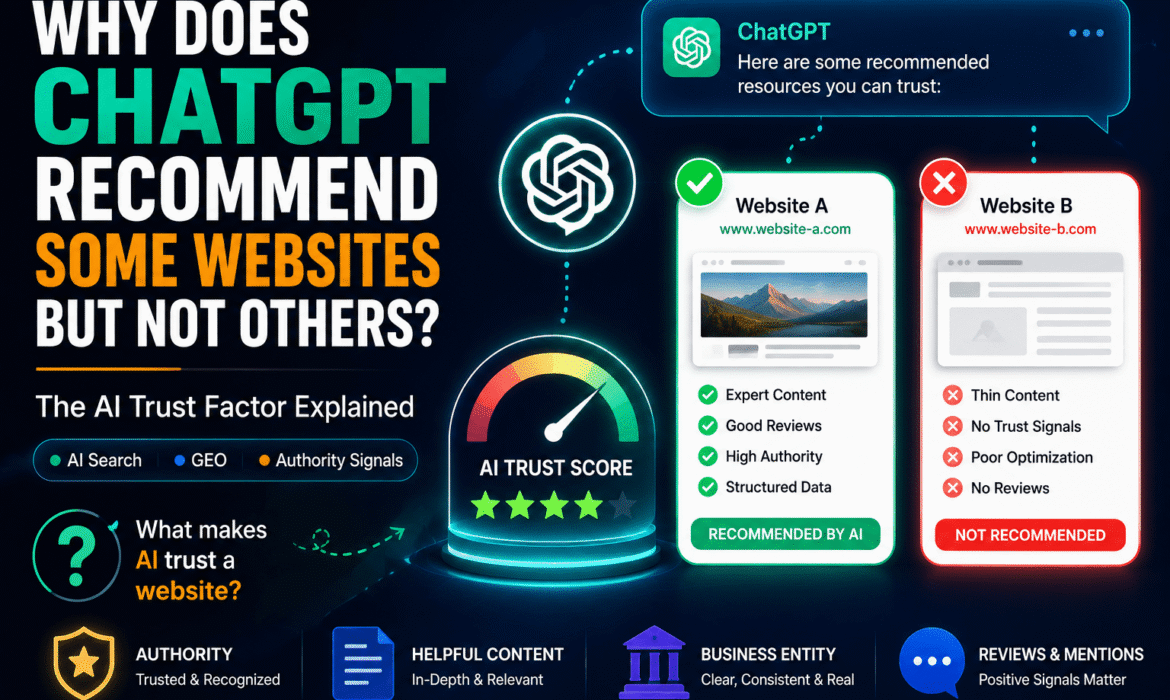
You search for a service on ChatGPT. It confidently names three businesses — with reasons, details, and sometimes contact information. Your business is not one of them. But your competitor is.
This is not random. ChatGPT recommends websites based on specific, identifiable signals — and understanding those signals is the first step toward getting your business recommended too.
This guide explains exactly why ChatGPT recommends some websites over others, what the deciding factors are, and precisely what Indian businesses can do to appear in ChatGPT’s responses in 2026.
ChatGPT does not rank websites the way Google does. It does not use a traditional algorithm based on backlinks and keyword density. Instead, ChatGPT recommends websites based on how confidently it can verify a business’s existence, expertise, and relevance to the user’s query.
ChatGPT is designed to be helpful and accurate. Consequently, it recommends sources it can verify — businesses and websites that appear consistently across multiple trusted sources with clear, factual, and well-structured information.
Furthermore, ChatGPT’s training data includes enormous amounts of web content — news articles, reviews, directories, forums, and websites. When a business appears across many of these sources consistently, ChatGPT builds confidence in recommending it. Moreover, when a business appears on only one or two platforms with thin information — ChatGPT simply does not have enough data to recommend it confidently.
ChatGPT recommends websites that directly answer the questions users ask. Furthermore, it strongly favours content written in a clear, factual, authoritative style — with specific information rather than vague marketing language.
A website that says “We provide quality advertising solutions” gives ChatGPT nothing specific to work with. A website that says “Baba Advertisers has provided newspaper advertising, digital marketing, outdoor hoardings, and radio and TV campaigns in Varanasi for over 28 years” gives ChatGPT specific, extractable facts it can confidently present to a user.
ChatGPT extracts content most effectively from pages structured as direct answers to specific questions. Moreover, question-and-answer formatted content — particularly FAQ sections — appears in ChatGPT responses significantly more often than paragraph-heavy generic content.
Additionally, content that includes specific numbers, dates, locations, and named services gives ChatGPT more material to draw from. Consequently, specificity and clarity are the two most important qualities for any content targeting ChatGPT visibility.
ChatGPT does not rely on a single source. When deciding whether to recommend a website, ChatGPT cross-references information across directories, review platforms, news articles, social media, and the business website simultaneously.
A business appearing consistently across Google Business Profile, JustDial, Sulekha, IndiaMart, Facebook, and its own website — with identical information everywhere — presents ChatGPT with strong, multi-source confirmation. Furthermore, this consistency signals reliability and credibility.
ChatGPT thinks in entities — recognisable, verifiable real-world things. The more sources confirm the same information about your business, the stronger your entity recognition becomes. Moreover, strong entity recognition is the single most important factor determining whether ChatGPT recommends your website in local business queries.
Consequently, businesses with inconsistent NAP information — different addresses or phone numbers on different platforms — confuse ChatGPT’s entity recognition system. This confusion directly reduces recommendation frequency.
This is one of the strongest signals ChatGPT uses to recommend websites. When credible external sources — news articles, industry publications, local media, and reputable directories — mention a business by name, ChatGPT treats these mentions as independent verification of the business’s existence and authority.
Moreover, a single mention in a respected local newspaper or industry publication carries significantly more weight than dozens of self-created directory listings. Furthermore, press releases, expert commentary contributions, and partner website mentions all build this external credibility signal progressively.
ChatGPT was trained on enormous amounts of news content. Consequently, businesses mentioned in news articles — even small local ones — receive disproportionately strong entity recognition in ChatGPT’s model. Moreover, this recognition persists across updates and new training cycles — making editorial mentions one of the most durable AI visibility investments available.
ChatGPT reads review content — not just star ratings. Furthermore, reviews that mention a business by name, describe specific services, and reference the location carry significantly more weight than one-word reviews like “Great!”
When someone asks ChatGPT “Which advertising agency in Varanasi is best for newspaper bookings?” — ChatGPT draws partly from review content describing specific service experiences. Moreover, a business with fifty detailed, specific reviews will consistently outperform a competitor with five generic ones — even if both have the same star rating.
Ask satisfied customers to mention your specific service and location in their review. Furthermore, a simple WhatsApp message after a completed service — “Could you mention the newspaper ad we placed and that we are based in Varanasi?” — produces exactly the kind of review content that feeds ChatGPT’s recommendation engine. Additionally, responding to every review adds further text content that ChatGPT reads and incorporates.
ChatGPT with browsing capability actively visits websites when gathering current information. Moreover, a website that loads slowly, fails on mobile, or returns errors provides ChatGPT with a poor experience — reducing its confidence in recommending that source.
Furthermore, page experience signals — loading speed, mobile responsiveness, and absence of technical errors — are increasingly factored into AI tool recommendations across all major platforms. Consequently, a fast, well-functioning website is both a user experience priority and a direct ChatGPT visibility requirement.
Use Google PageSpeed Insights to check your current score. Moreover, address the most common speed issues — uncompressed images, render-blocking scripts, and slow hosting — because these affect both Google rankings and ChatGPT recommendation confidence simultaneously.
Schema markup is the language that AI tools — including ChatGPT’s browsing capability — read most efficiently. It provides machine-readable information about your business, content, and services in a format that eliminates ambiguity entirely.
The schema types most relevant to ChatGPT recommendations:
Moreover, businesses with comprehensive schema markup consistently appear in ChatGPT responses more frequently than equivalent businesses without it. Additionally, schema is currently one of the lowest-competition, highest-impact optimisations available to Indian businesses in 2026.
ChatGPT favours websites that demonstrate genuine depth of knowledge in a specific subject area. A website with one page about advertising will always lose to one with thirty detailed, well-structured articles covering every aspect of the advertising industry.
Furthermore, regular content publication signals to ChatGPT that a website is actively maintained and current — a strong trust signal for a tool designed to provide accurate, up-to-date recommendations.
When a website consistently covers a specific topic comprehensively — newspaper advertising, digital campaigns, outdoor hoardings, radio bookings, local SEO — ChatGPT learns to associate that website with that subject area. Consequently, any query related to those topics increasingly surfaces that website as a recommended source.
At Baba Advertisers, our digital marketing team helps businesses build exactly this kind of topical authority content strategy — creating the consistent, expert content that makes ChatGPT recommend your website over competitors.
ChatGPT draws heavily from Google Business Profile data when answering local business queries — particularly through its integration with browsing tools and its training on Google-indexed content. Moreover, a complete, active Google Business Profile strengthens entity recognition across every major AI platform simultaneously.
Furthermore, a business with a complete profile — including all services listed individually, weekly posts, regular photo uploads, and consistent review responses — signals active operation and genuine market presence. Consequently, this activity level directly increases the frequency with which ChatGPT recommends that website for relevant local queries.
Understanding the blockers is as important as understanding the enablers. ChatGPT will not recommend your website if:
Moreover, all of these blockers are fixable. Furthermore, fixing them produces improvements across both ChatGPT and Google visibility simultaneously — because both systems value the same underlying qualities.
Getting ChatGPT to recommend your website builds powerful digital visibility. However, the fastest-growing businesses in Varanasi combine AI visibility with traditional advertising that reaches customers across every channel.
A newspaper advertisement in Dainik Jagran or Hindustan builds immediate credibility with audiences who may never use ChatGPT. An outdoor hoarding at a prime Varanasi location keeps your brand visible 24 hours a day. Radio and TV advertising delivers mass awareness that no digital strategy alone achieves.
Together, these channels create a complete brand presence that AI tools recognise, customers trust, and competitors struggle to replicate quickly.
Why does ChatGPT recommend some websites but not others? ChatGPT recommends websites it can verify as credible, relevant, and authoritative through multiple signals — including factual content, consistent business information across platforms, credible external mentions, detailed customer reviews, structured data schema, and an active Google Business Profile. Businesses missing several of these signals simply do not appear in ChatGPT’s recommendations.
How do I get ChatGPT to recommend my business? To get ChatGPT to recommend your business, ensure your website contains clear, factual, specific content structured as direct answers to customer questions. Additionally, maintain consistent business information across all platforms, build credible external mentions, collect detailed customer reviews, implement schema markup, and keep your Google Business Profile active and complete.
Does ChatGPT use Google reviews when making recommendations? Yes — ChatGPT draws from Google review content when making local business recommendations. Reviews mentioning specific services, locations, and business names carry significantly more weight than generic one-word reviews. Furthermore, consistently responding to reviews adds additional content that ChatGPT incorporates into its business assessment.
How long does it take for ChatGPT to start recommending my website? Businesses implementing factual content restructuring, FAQ schema, consistent entity signals, and active Google Business Profile optimisation typically begin appearing in ChatGPT recommendations within four to eight weeks. However, sustained AI visibility requires ongoing content publication, review collection, and profile maintenance.
Can a small business in Varanasi appear in ChatGPT recommendations? Absolutely. ChatGPT favours factual accuracy, content clarity, and entity consistency over business size. A well-optimised small business in Varanasi can appear in ChatGPT recommendations ahead of large national brands whose websites are less specifically structured for AI extraction.
Understanding why ChatGPT recommends some websites over others is the first step. Implementing the changes consistently — content restructuring, schema markup, entity consistency, review strategy, and profile optimisation — requires ongoing expertise and attention.
At Baba Advertisers, our digital marketing team handles complete AI visibility optimisation for businesses across Varanasi — so you can focus on running your business while we focus on making ChatGPT, Gemini, and Google AI recommend it.
Contact us today for a free AI visibility audit. We will assess your current ChatGPT and AI search presence, identify exactly what is preventing your business from being recommended, and build a practical strategy to fix it.
According to Princeton University’s research on Generative Engine Optimisation, websites with authoritative, well-structured, citation-backed content are significantly more likely to appear in AI-generated responses. Content quality and structural clarity are the defining factors of ChatGPT recommendation frequency.
⚠️ Disclaimer: This blog reflects current best practices in AI search optimisation as of 2026. Digital platforms evolve rapidly — strategies should be reviewed and updated regularly.