
Based in Varanasi since 1997, BABA Advertisers is a leading advertising agency in Varanasi, India, with a rich legacy of driving remarkable sales for our clients through comprehensive digital advertising services.

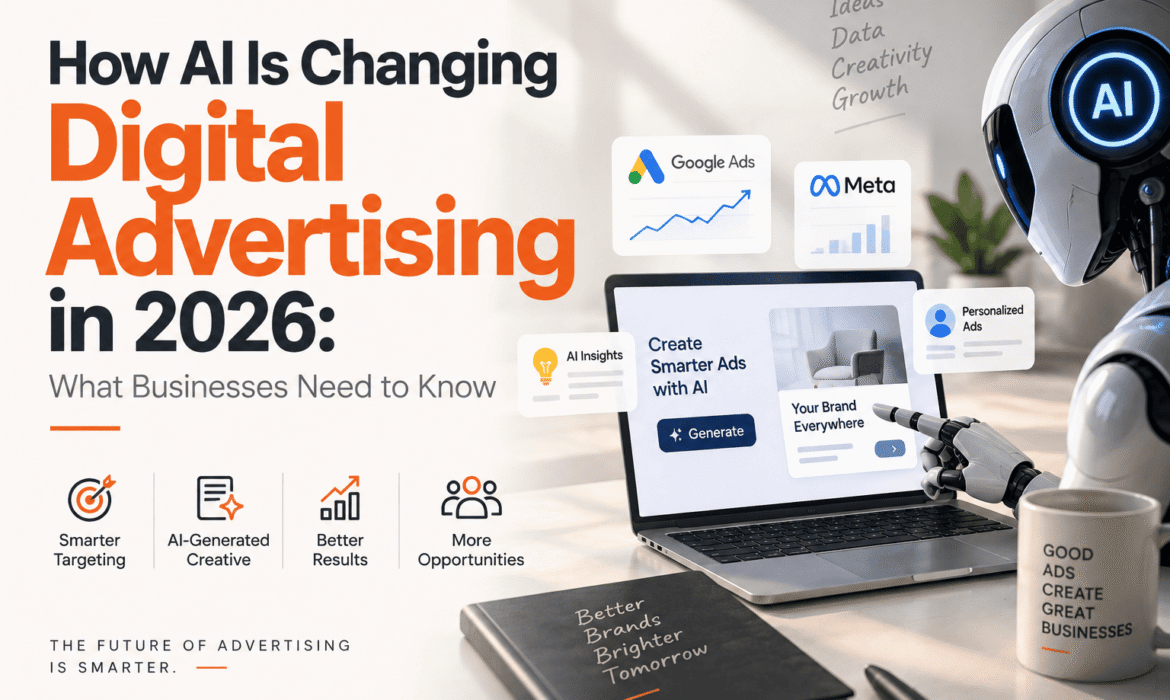
Running an ad campaign in 2026 looks fundamentally different from just a few years ago, and the change goes deeper than a few new features. AI is changing digital advertising at its core — how bids get set, how audiences get targeted, and increasingly, how the ads themselves get made. For businesses spending real money on advertising, understanding this shift isn’t optional anymore. Here’s what’s actually changed, and what it means for how you should run campaigns going forward.
For years, automated bidding was something advertisers could choose to try. That’s no longer the case. Major platforms have moved automation from an optional feature to the built-in default. Google’s Performance Max and AI Max campaigns, along with Meta’s Advantage+, now handle bidding, audience targeting, creative assembly, and placement with minimal manual input from advertisers.
This shift accelerated further in September 2026, when Google began automatically migrating older Broad Match campaigns and legacy automated asset campaigns into its AI Max system. Microsoft followed with a similar move, turning on its own AI Max system by default for new Search campaigns. In practice, this means many advertisers are inheriting AI-driven campaign structures whether they actively chose them or not.
With platforms handling the mechanical decisions, the advertiser’s role has shifted from hands-on campaign management toward strategic direction — setting clear goals and feeding the system quality data, rather than manually adjusting bids or guessing which creative will perform. The businesses seeing the strongest results tend to treat this as a shift in focus, not a loss of control, spending more time on strategy and messaging and less on manual optimization.
AI-driven targeting works by learning from data, and the quality of that data directly affects results. Industry research shows campaigns combining first-party data with AI-based contextual targeting can deliver up to twice the return on ad spend compared to relying on third-party targeting alone. For a small business, this means the customer data you collect directly — enquiry forms, past purchases, repeat customers — has become a genuine competitive advantage, not just a nice-to-have.
One of the more significant shifts is Dynamic Creative Optimization, or DCO — an AI-driven process that automatically adjusts an ad’s headline, image, offer, and format based on exactly who’s seeing it and when. Rather than showing everyone the same static ad, DCO assembles a version tailored to each viewer’s context in real time.
Early results suggest this approach genuinely outperforms static creative, with campaigns using DCO reportedly seeing meaningfully higher click-through rates and lower costs per click. For businesses still running one-size-fits-all ad creative, this represents one of the clearer opportunities available right now.
Generative AI now produces ad visuals, copy variations, and even video content directly within ad platforms. Meta’s Advantage+ Creative, for instance, can automatically rewrite text within uploaded ad images and generate multiple headline variants while preserving the original design’s fonts and colors. Some industry benchmarks now show AI-generated creative achieving click-through rates that rival or exceed human-only designs, particularly for lower-priced products.
This doesn’t mean creative direction has become unnecessary — if anything, the opposite. With platforms increasingly handling execution, human judgment in shaping brand voice, reviewing AI output for accuracy, and maintaining consistency has become the area where businesses can genuinely differentiate themselves.
Because platforms now bundle targeting, creative generation, and placement decisions into largely automated systems, it’s become easier than ever to simply accept whatever the platform defaults to, rather than actively directing the strategy. Most small businesses don’t deliberately choose this path — they simply inherit it by not engaging with the settings and inputs that shape how AI makes decisions on their behalf. Left unmanaged, this can lead to wasted spend or ads that don’t reflect what actually differentiates the business.
This shift in advertising mechanics is happening alongside a broader move toward AI-influenced search and discovery, meaning businesses now need to think about AI’s role across both paid advertising and organic visibility. Our AI search visibility checklist covers the organic side of this shift in practical detail.
Largely, yes, provided they’re set up thoughtfully. The platforms have invested heavily in these systems because they generally do improve efficiency and results at scale. The risk isn’t AI itself — it’s disengaging entirely and assuming the system will figure out your business’s specific goals without clear input. Businesses comparing Google Ads and social media advertising should factor this shift in, since both major platforms now operate on largely AI-driven foundations.
Understanding what AI is doing behind the scenes of your campaigns, and making sure it’s working in your favor rather than running on autopilot without direction, takes ongoing attention. Baba Advertisers’ digital advertising services help businesses in Varanasi and beyond navigate AI-driven ad platforms strategically, so automation works for your specific goals rather than just running on default settings.
Do I have any control over AI-driven ad campaigns, or does the platform decide everything? You still control the goals, budget, creative direction, and the data you feed the system. The platform automates execution — bidding, targeting, and placement — but strategic decisions remain with the advertiser.
Is AI-generated ad creative as effective as human-made ads? Some benchmarks show AI-generated creative performing comparably or even better for certain products, particularly lower-priced items, though human oversight remains important for brand accuracy and consistency.
Why does first-party data matter more with AI-driven advertising? AI targeting systems learn from the data they’re given. Accurate, complete first-party data — like enquiry and conversion records — leads to meaningfully better targeting results than relying on third-party data alone.
Should I just accept the default AI settings on Google or Meta ads? Not without reviewing them first. Defaults work reasonably well for many advertisers, but actively reviewing settings and inputs generally produces better results than accepting them unchecked.
What is Dynamic Creative Optimization (DCO)? DCO is an AI-driven process that automatically adjusts ad elements like headlines, images, and offers based on who’s viewing the ad, aiming to improve relevance and performance in real time.
Related Reads:
Want your ad campaigns actually working with AI, not just running on autopilot? Talk to Baba Advertisers — we’ll help you navigate AI-driven advertising with a strategy built around your business.





Based in Varanasi since 1997, BABA Advertisers is a leading advertising agency in Varanasi, India, with a rich legacy of driving remarkable sales for our clients through comprehensive digital advertising services.