
Based in Varanasi since 1997, BABA Advertisers is a leading advertising agency in Varanasi, India, with a rich legacy of driving remarkable sales for our clients through comprehensive digital advertising services.

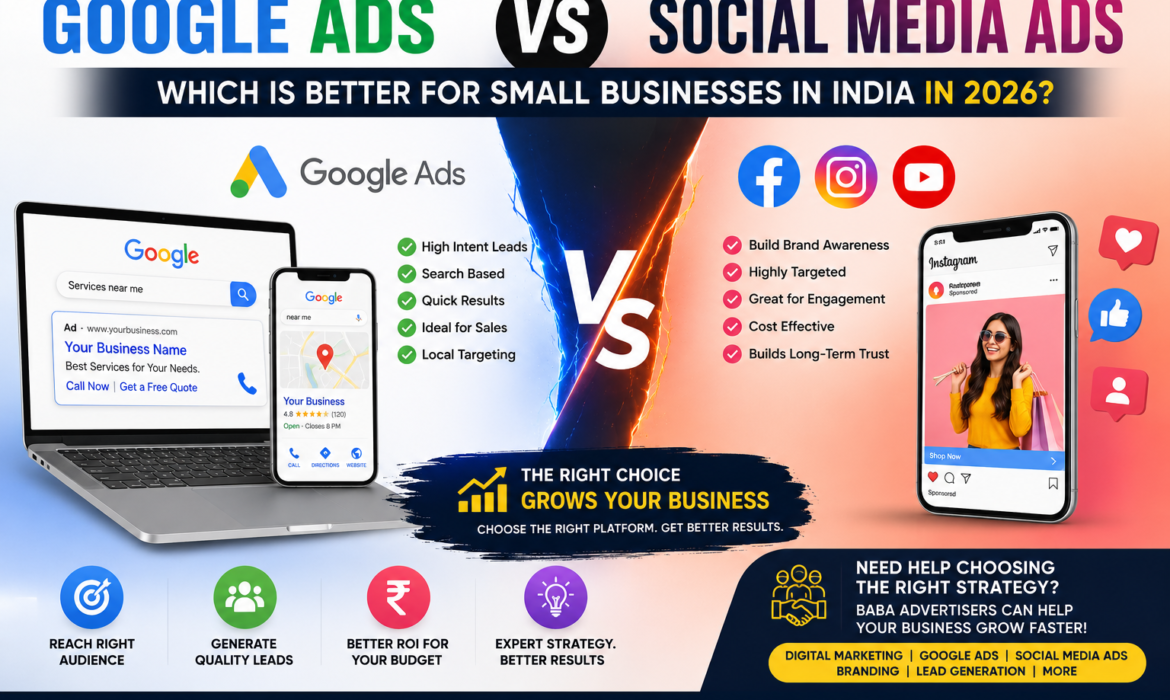
If you have a limited advertising budget and are trying to decide where to spend it, the Google Ads vs Social Media Ads debate is one of the most important questions for small businesses in India right now.
Both platforms work. Both can deliver real results. But they work very differently — and the right choice depends entirely on your business type, your goals, and your target audience. Spending money on the wrong platform is one of the most common and costly mistakes small business owners make.
This guide gives you an honest, practical comparison — so you can make the right decision for your business in 2026.
Before comparing costs and features, it is essential to understand the fundamental difference between these two types of advertising.
Google Ads targets people who are already searching for what you offer. Someone types “advertising agency in Varanasi” or “best restaurant near me” — and your ad appears. This is called intent-based advertising. The person already wants what you sell. You are simply making sure they find you first.
Social Media Ads — on platforms like Facebook, Instagram, and YouTube — target people based on who they are, not what they are searching for right now. A 28-year-old business owner in Varanasi who has shown interest in marketing sees your ad while scrolling their feed. They were not looking for you — but your ad introduces your brand to them. This is called discovery-based advertising.
Understanding this difference is the key to choosing the right platform for your goals.
High purchase intent. People searching on Google are often ready to buy or at least seriously considering it. A search for “newspaper advertising agency in Varanasi” is coming from someone who needs that service right now — not someone casually browsing.
Faster results. Google Ads can start generating leads within hours of going live. For businesses that need immediate enquiries — a new shop opening, a seasonal offer, or a service with high demand — Google Ads delivers speed that organic SEO simply cannot match.
Measurable ROI. Google Ads gives you precise data — how many people saw your ad, clicked it, called your number, or filled a form. Every rupee spent is trackable.
Works in every city. Whether you are in Varanasi, Lucknow, or a smaller town — if people are searching for your service on Google, you can reach them.
Competitive keywords can be expensive. In highly competitive industries — insurance, legal services, real estate — the cost per click can be very high, making it difficult for smaller businesses with tight budgets to compete.
No demand creation. If nobody is searching for your product or service yet, Google Ads cannot help. It only captures existing demand — it does not create new demand.
Requires ongoing management. A poorly set-up Google Ads campaign will waste money very quickly. Keyword selection, match types, negative keywords, and bid strategy all require expertise to get right.
Unmatched audience targeting. Facebook and Instagram allow you to target by age, gender, location, interest, income bracket, job title, and behaviour. For a clothing boutique targeting women aged 22 to 40 in Varanasi who are interested in fashion — social media ads are extraordinarily precise.
Visual storytelling. Products, food, fashion, interiors, beauty services — anything visual performs brilliantly on Instagram and Facebook. A well-produced Reel or carousel ad can stop a scroll and create desire for something a customer did not even know they wanted.
Lower entry cost. Social media ads can be started with a very small daily budget — even ₹200 to ₹500 per day — and still reach a meaningful audience. For very small businesses just starting out, this lower barrier makes experimentation accessible.
Brand building over time. Even when someone does not click your ad immediately, repeated exposure builds familiarity and trust. Social media ads compound over time in a way that search ads do not.
Lower immediate purchase intent. Most people on Instagram or Facebook are in entertainment or social mode — not buying mode. Conversion rates are typically lower than Google Ads for services with high immediate intent.
Ad fatigue is real. Indian social media users are exposed to dozens of ads every day. Standing out requires consistently fresh, high-quality creative content — which takes time, skill, and ongoing investment.
Algorithm changes affect results. Platform algorithms change frequently. What worked six months ago on Instagram may not work the same way today — requiring constant adaptation.
| Factor | Google Ads | Social Media Ads |
|---|---|---|
| Best for | High-intent, ready-to-buy customers | Brand awareness and new audience discovery |
| Average cost | Higher CPC, but higher intent | Lower CPC, but lower immediate conversion |
| Speed of results | Fast — leads within hours | Slower — builds over time |
| Best business types | Services, local businesses, urgent needs | Products, lifestyle brands, e-commerce |
| Creative requirement | Text-based, keyword-focused | Visual — image, video, carousel |
| Targeting method | Keyword and search intent | Demographics, interests, behaviour |
| Brand building | Limited | Strong |
| Measurability | Very high | High |
Choose Google Ads first if:
Choose Social Media Ads first if:
Use both if:
The most effective digital advertising strategies for Indian small businesses in 2026 combine both platforms — using Google Ads to capture ready buyers and social media ads to build brand awareness with the wider audience.
For businesses in cities like Varanasi, digital advertising is only part of the picture. Many high-value customers — particularly in the 35 and above age group — are influenced significantly by what they read, see, and hear in traditional media.
A newspaper advertisement in Dainik Jagran or Hindustan builds immediate credibility and reaches audiences that digital ads simply do not. An outdoor hoarding in a prime Varanasi location keeps your brand visible 24 hours a day to thousands of people passing by. Radio and TV advertising delivers mass awareness at scale.
The businesses that grow fastest in Varanasi combine the precision of digital with the reach and trust of traditional media — creating a complete, multi-channel presence that no single platform alone can deliver.
According to Google’s own research on cross-channel advertising, businesses that use multiple advertising channels consistently achieve higher brand recall and conversion rates than those relying on a single platform.
Choosing between Google Ads and Social Media Ads — or deciding how to combine them with traditional advertising — is not always straightforward. The right mix depends on your specific business, your audience, your budget, and your growth goals.
At Baba Advertisers, our digital advertising team helps businesses in Varanasi plan and execute the right combination of online and offline advertising — with clear goals, transparent reporting, and results you can measure.
Contact us today for a free consultation. We will look at your business, your market, and your budget — and recommend exactly where your advertising rupees will work hardest.