
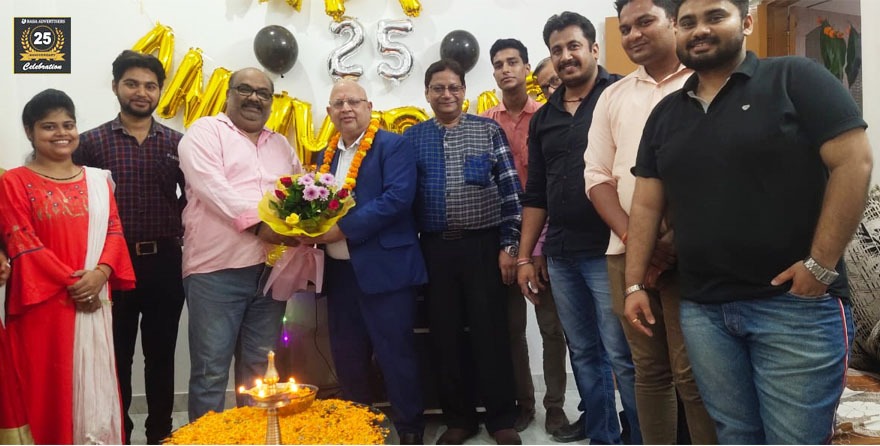

Based in Varanasi since 1997, BABA Advertisers is a leading advertising agency in Varanasi, India, with a rich legacy of driving remarkable sales for our clients through comprehensive digital advertising services.

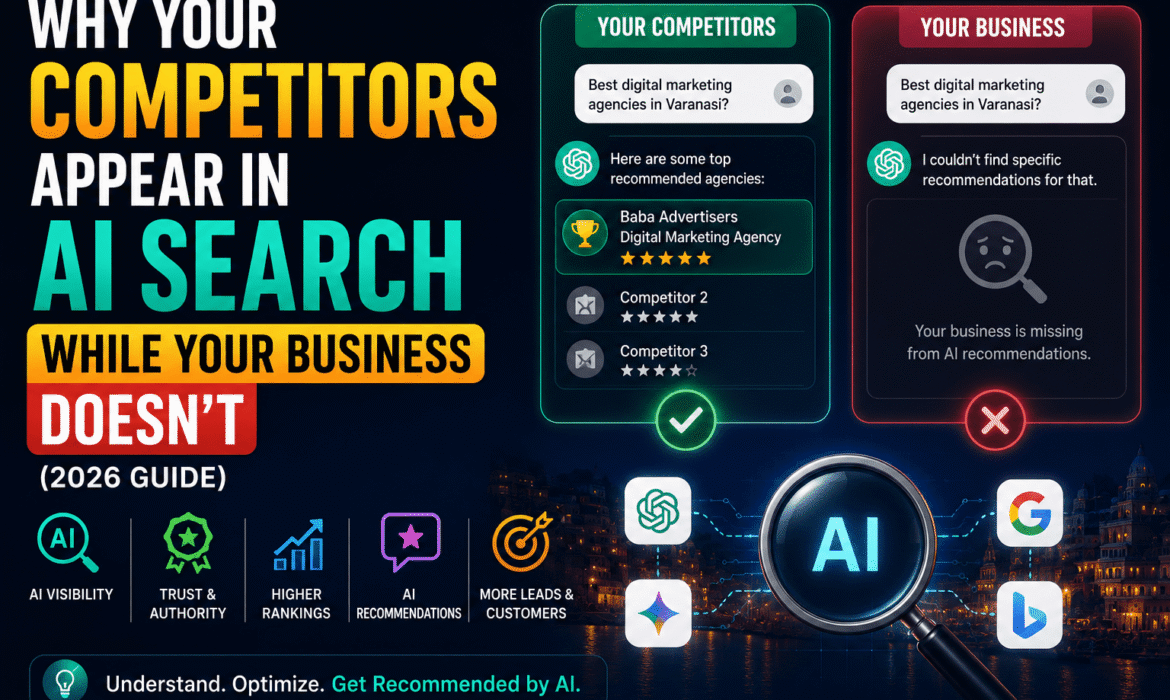
You ask ChatGPT or Google Gemini which advertising agency to use in Varanasi. Your competitor’s name appears immediately — with specific details and a confident recommendation. Your business does not appear at all.
This is happening to thousands of Indian business owners right now. Moreover, most of them have no idea why their competitors appear in AI search while they remain completely invisible. Furthermore, many of them have better services, more experience, and stronger client relationships — yet AI tools consistently recommend their competitors instead.
This guide explains exactly why competitors appear in AI search while your business does not — and precisely what you can do to close this gap in 2026.
Your competitors appear in AI search because they have specific signals that AI tools — ChatGPT, Gemini, Perplexity, and Google AI Overviews — use to identify credible, relevant businesses. These signals include factual website content, FAQ schema, complete Google Business Profiles, consistent entity data across platforms, detailed customer reviews, and credible external mentions. Your business is invisible in AI search because one or more of these signals is missing, incomplete, or inconsistent.
Understanding why your competitors appear in AI search first requires understanding how AI tools make recommendations. Traditional Google ranks websites using hundreds of algorithm signals — primarily backlinks and keywords. AI tools work completely differently.
AI tools generate answers — they do not display lists of ranked websites. Moreover, when someone asks ChatGPT “Which advertising agency in Varanasi is best?” — ChatGPT produces one confident answer. It names one or two businesses specifically. Consequently, if your competitor is named and you are not — you have effectively lost that customer entirely.
In traditional Google search, ten businesses appear on page one — giving multiple competitors a chance. In AI search, one or two businesses get recommended. Moreover, the others receive zero visibility — regardless of how close they came to being mentioned.
Furthermore, AI tools repeat their recommendations consistently. A business that appears in AI search today tends to appear again tomorrow — because AI tools build confidence in sources they have previously found credible. Consequently, the gap between visible and invisible businesses in AI search widens progressively over time.
Check each item for your business and your competitor:
| Signal | Your Competitor | Your Business |
|---|---|---|
| Google Business Profile complete and active | ✅ Likely yes | ☐ Check now |
| Website has specific, factual Q&A content | ✅ Likely yes | ☐ Check now |
| FAQ section with FAQPage schema | ✅ Likely yes | ☐ Check now |
| NAP identical across all platforms | ✅ Likely yes | ☐ Check now |
| 10+ detailed Google reviews | ✅ Likely yes | ☐ Check now |
| Mentioned in local news or industry source | ✅ Likely yes | ☐ Check now |
| LocalBusiness schema on website | ✅ Likely yes | ☐ Check now |
| Regular content published — 2x per month | ✅ Likely yes | ☐ Check now |
| llms.txt file at root URL | ✅ Possibly yes | ☐ Check now |
| Website loads in under 3 seconds on mobile | ✅ Likely yes | ☐ Check now |
Every gap you identify is a reason your competitors appear in AI search while you do not. Moreover, every gap is fixable — often within days rather than months.
Google AI Overviews and Gemini pull directly from Google Business Profile data when answering local business queries. Moreover, a complete profile with every field filled, weekly posts, and regular photo uploads signals active operation and trustworthiness to Google AI.
Your competitor’s complete profile gives Google AI everything it needs to confidently recommend them. Furthermore, your incomplete profile — missing services, outdated hours, or no photos — gives Google AI insufficient data to recommend you with confidence.
Fix it:
Log into your Google Business Profile today. Fill every field — services, description, hours, and website. Post a weekly update. Upload at least five new photos. Respond to every existing review. Moreover, write your business description as clear, factual sentences — not a marketing slogan.
AI tools extract content most effectively from pages that directly answer the specific question a user asked. Moreover, your competitor’s website likely opens service pages with sentences like “Baba Advertisers handles newspaper ad bookings across Varanasi — including Dainik Jagran, Hindustan, and Amar Ujala.”
Your website may open with “We provide premium quality advertising solutions.” Furthermore, this vague phrasing gives AI tools nothing specific to extract. Consequently, AI tools confidently cite your competitor’s content and ignore yours entirely.
Fix it:
Rewrite every key service page to begin with a direct, specific answer to the question a customer would ask. Include your business name, location, specific services, and years of experience in the first two sentences. At Baba Advertisers, our digital marketing team restructures website content specifically for AI extraction — closing this gap efficiently.
FAQ schema markup is one of the most direct pathways to appearing in Google AI Overviews. Moreover, Google’s AI system specifically extracts FAQPage schema content when generating answers to question-based queries.
Your competitor has implemented FAQ schema on their homepage and service pages. Furthermore, this means Google AI can read their questions and answers in a structured, machine-readable format — and extract them directly into AI-generated responses.
Fix it:
Add five to ten FAQs to every important page. Implement FAQPage schema using Yoast SEO or Rank Math. Write each question conversationally — the way a real customer would ask it. Moreover, include your business name and location naturally within each answer — not just in the question.
AI tools cross-reference your business information across multiple sources before recommending you. Your competitor’s name, address, and phone number are identical across every platform — Google Business Profile, JustDial, Sulekha, IndiaMart, Facebook, and their website.
Your business may have a slightly different address format on JustDial. Furthermore, your phone number may include a +91 prefix on some platforms but not others. Consequently, these small inconsistencies create doubt in AI systems — and doubt produces invisibility.
Fix it:
Audit every platform where your business appears. Write your exact business name, address, and phone number — in one standardised format. Update every platform to match exactly. Moreover, use your complete, legal business name everywhere — never abbreviations or informal variations.
Your competitor has fifty reviews mentioning specific services — “Their newspaper ad booking process for Dainik Jagran was seamless” or “The outdoor hoarding placement in Lanka was exactly where we needed it.” AI tools read this content directly when generating local business recommendations.
Your business may have twenty reviews — but most say “Good service” or “Nice team.” Furthermore, generic reviews provide AI tools with almost no specific information about your services, location, or differentiators. Consequently, AI tools cannot use your reviews to generate specific, confident recommendations.
Fix it:
After every completed service, send a WhatsApp follow-up — “Could you mention the specific service we provided and that we are based in Varanasi in your Google review?” Moreover, respond to every review — positive and negative — because your responses add additional specific content that AI tools incorporate.
ChatGPT and Perplexity weight mentions from credible external sources very heavily. Your competitor may have been featured in a local Varanasi news article, quoted in an industry publication, or mentioned on a reputable directory with editorial standards.
Each credible external mention builds independent entity verification — telling AI tools that your competitor’s existence and authority has been confirmed by trusted third parties. Furthermore, your business, without any such mentions, lacks this independent verification signal entirely.
Fix it:
Actively pursue editorial mentions — reach out to local Varanasi journalists, issue press releases for milestones, and contribute expert commentary to relevant publications. Moreover, a single quality news mention often has more AI visibility impact than months of website optimisation alone.
AI tools assess content recency and publication frequency alongside quality. Your competitor publishes two to four blog posts per month — covering every topic related to their industry. Moreover, this consistent activity signals to AI tools that the website is actively maintained and currently relevant.
Your last blog post was published six months ago. Furthermore, AI tools interpret this inactivity as a potential sign that the business is less active or relevant than actively publishing competitors. Consequently, consistent publishers consistently outperform infrequent ones in AI search — regardless of the quality of older content.
Fix it:
Publish at minimum two blog posts per month. Cover topics your customers ask AI tools about — advertising costs, platform comparisons, campaign strategies, and local market insights. Moreover, update existing important pages regularly — because freshness signals matter to AI tools alongside publication frequency.
Your competitor has implemented LocalBusiness schema, FAQPage schema, and Article schema across their website. This structured data tells AI tools — in a precise, machine-readable format — exactly what the business is, where it operates, what it offers, and how to contact it.
Your website has no schema markup. Furthermore, without schema, AI tools must interpret your website content independently — a far less reliable process that frequently produces inaccurate or incomplete understanding.
Fix it:
Implement LocalBusiness schema on your homepage, FAQPage schema on pages with FAQ sections, and Article schema on blog posts. Moreover, Service schema on individual service pages tells AI tools specifically what each service involves — dramatically improving the accuracy of AI-generated descriptions of your business.
ChatGPT with browsing and Google AI systems both assess page experience when evaluating websites as recommendation sources. Your competitor’s website loads in under two seconds on mobile. Yours takes five seconds.
Moreover, this performance gap signals to AI tools that your competitor maintains their digital presence more professionally. Furthermore, in India — where most users access websites on mobile data connections — a slow website creates a poor experience that AI tools factor into their source quality assessment.
Fix it:
Test your website at Google PageSpeed Insights. Address the most impactful issues — uncompressed images, render-blocking scripts, and slow hosting. Moreover, a website that loads fast earns both better AI visibility and better user experience simultaneously.
Your competitor may have already implemented an llms.txt file — the emerging standard that tells AI language models exactly what a website is about and which pages matter most. Moreover, this file gives AI tools a direct, structured guide to your competitor’s content — eliminating any ambiguity about their services, location, and expertise.
Your website has no llms.txt. Consequently, AI tools must independently determine what your business does — a slower, less accurate process that disadvantages you against competitors who have provided clear guidance.
Fix it:
Create a plain text file at yourwebsite.com/llms.txt containing your business summary, key page URLs, service descriptions, and location details. Furthermore, update it every three to six months as your services and pages evolve.
| 🔴 Myth | 🟢 Fact |
|---|---|
| “My competitor paid AI tools to appear” | AI recommendations are organic — not paid placements |
| “I need a bigger budget to appear in AI search” | AI visibility depends on content quality and entity signals — not budget size |
| “My Google ranking determines AI visibility” | AI search is a separate system — high Google rankings do not guarantee AI visibility |
| “AI search only matters for large businesses” | Local businesses in smaller cities gain the most from early AI visibility adoption |
| “Fixing this takes years” | Many AI visibility improvements produce results within four to eight weeks |
| “My competitor must have insider connections” | They simply implemented the right signals earlier — all of which you can implement too |
Why do my competitors appear in ChatGPT but not my business?
Your competitors appear in ChatGPT because they have specific signals ChatGPT uses to identify credible businesses — factual Q&A content, consistent entity data, detailed reviews, external mentions, and active Google Business Profiles. Your business is missing one or more of these signals. Moreover, implementing them produces measurable AI visibility improvement within four to eight weeks.
How do I check if my business appears in AI search?
Ask ChatGPT, Gemini, and Perplexity directly — “Which [your business type] in [your city] do you recommend?” Moreover, vary the question phrasing — “Best [service] near [city]” and “Top [business type] in [city]” — because AI tools respond differently to different query formulations. This simple test reveals exactly where your AI visibility gaps are.
Can a local business in Varanasi compete with larger brands in AI search?
Yes — and this is one of the most significant opportunities for local Indian businesses right now. AI tools favour specificity and local relevance over brand size. A well-optimised local business in Varanasi with specific, factual content and consistent entity signals consistently outperforms large national brands with generic, location-agnostic content.
How long does it take to appear in AI search after fixing these issues?
Most businesses begin appearing in AI search within four to eight weeks of implementing structured content, FAQ schema, consistent entity signals, and active Google Business Profile management. Furthermore, AI citation frequency increases progressively as AI tools build greater confidence in your content over time.
What is the single most important AI visibility fix?
Complete your Google Business Profile first — it is the single highest-impact action for local businesses in India. Moreover, it directly influences Google AI Overviews and Gemini recommendations — the two platforms with the highest local query volume in India currently.
Every day your competitors appear in AI search while you do not is a day they capture customers you should be winning. Moreover, the AI visibility gap widens progressively — because AI tools build increasing confidence in competitors they have already cited.
Act immediately if:
Furthermore, the businesses implementing AI visibility strategies now — while most Indian competitors are still unaware — are building a compounding advantage that becomes progressively harder to close as AI search adoption accelerates.
Why do competitors appear in AI search results but not my business?
Competitors appear in AI search because they have implemented specific signals AI tools use to identify credible, relevant businesses — complete Google Business Profiles, specific Q&A content, FAQ schema, consistent entity data, detailed reviews, and credible external mentions. Your business is missing one or more of these signals — all of which are fixable.
Does traditional SEO help with AI search visibility?
Partially — traditional SEO foundations like fast loading, mobile optimisation, and quality content support AI visibility. However, AI search requires additional specific implementations — FAQ schema, LocalBusiness schema, consistent entity signals, and llms.txt — that traditional SEO alone does not address.
How do I stop my competitors from outranking me in AI search?
Implement all ten signals covered in this guide systematically. Start with Google Business Profile completion and FAQ schema — the two highest-impact changes. Furthermore, collect two to three detailed reviews monthly and publish consistent content — because recency and review quality directly determine AI recommendation frequency.
Is AI search visibility more important than Google SEO in 2026?
Both matter — and they are complementary rather than competing priorities. Traditional SEO still drives significant traffic through conventional search results. Moreover, AI search captures a rapidly growing proportion of local business recommendation queries. Businesses optimising for both simultaneously gain the strongest overall visibility across every search touchpoint.
How does Baba Advertisers help businesses appear in AI search?
Baba Advertisers provides complete AI search optimisation services for businesses in Varanasi — including content restructuring for AI extraction, FAQ and LocalBusiness schema implementation, Google Business Profile management, review strategy, external mention building, and integrated traditional advertising that amplifies digital AI visibility across every channel.
Your competitors appear in AI search while you do not — because they implemented specific signals first. However, this gap is entirely closeable. Moreover, the businesses that act now — while most Indian competitors are still learning about AI search — gain a first-mover advantage that compounds over time.
As the best advertising agency in Varanasi, Baba Advertisers combines over 28 years of local market expertise with complete AI search optimisation — building the content authority, entity consistency, and external presence that makes AI tools recommend your business ahead of every competitor.
From newspaper advertising that generates brand searches to outdoor hoardings that drive offline awareness — and radio and TV campaigns that create mass recognition — we build complete advertising presence that amplifies your AI visibility across every channel simultaneously.
Contact us today for a free AI visibility audit. We will identify exactly why your competitors appear in AI search while you do not — and build a practical, step-by-step strategy to reverse it.
According to Princeton University’s research on Generative Engine Optimisation, websites with authoritative, well-structured, citation-backed content are significantly more likely to appear in AI-generated responses — confirming that the signals covered in this guide directly determine which businesses AI tools recommend.
⚠️ Disclaimer: This blog reflects current best practices in AI search optimisation as of 2026. AI platforms evolve rapidly — strategies should be reviewed and updated regularly.