
Based in Varanasi since 1997, BABA Advertisers is a leading advertising agency in Varanasi, India, with a rich legacy of driving remarkable sales for our clients through comprehensive digital advertising services.

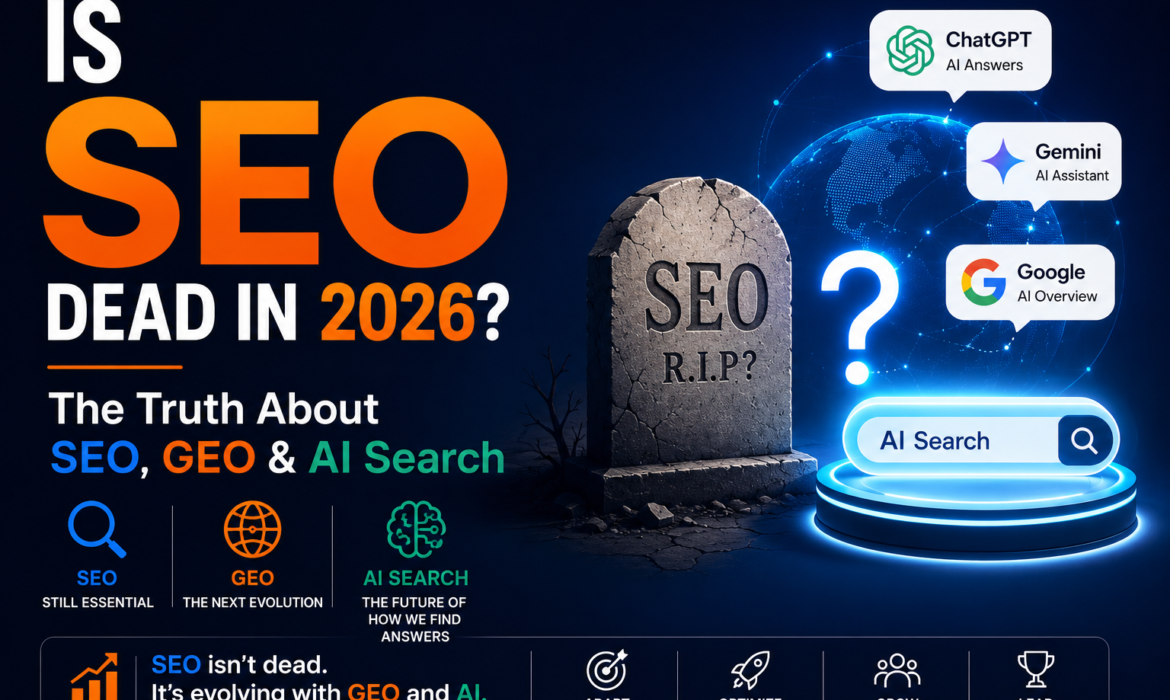
Every few years, someone declares that SEO is dead. In 2026, however, that claim feels more urgent than ever — because something genuinely significant has changed. Is SEO dead in 2026? The honest answer is neither a simple yes nor a simple no. Moreover, getting this answer wrong could cost your business significant visibility at a critical moment.
Traditional SEO — the practice of ranking web pages on Google through keywords, backlinks, and technical optimisation — is not dead. However, it is no longer sufficient on its own. A new layer has emerged on top of traditional search, and businesses that fail to adapt to it are already losing customers they do not even know they are missing.
This guide gives you the complete, honest picture — what has changed, what still works, what is replacing it, and exactly what Indian businesses need to do in 2026 to stay visible.
To answer the SEO question honestly, understanding what has genuinely shifted in search behaviour is essential.
In 2025 and 2026, Google rolled out AI Overviews across India at significant scale. These AI-generated summaries now appear above traditional search results for a large and growing percentage of queries — particularly informational, local, and question-based searches. Furthermore, Google Gemini is now deeply embedded in Android devices used by hundreds of millions of Indians, answering questions directly without requiring a search results page at all.
Simultaneously, ChatGPT surpassed 100 million daily active users globally, with a rapidly growing proportion coming from India’s urban population. Additionally, Perplexity and other AI search tools are capturing an increasingly significant share of the research and discovery queries that previously drove traffic to websites via Google.
Consequently, the traditional model — optimise for Google, rank on page one, receive traffic — is no longer the complete picture. A new model has emerged alongside it, and businesses need to operate in both simultaneously.
Despite the emergence of AI search, traditional SEO remains very much alive for specific types of queries and business goals. Here is what continues to work effectively:
Transactional searches still drive significant Google traffic. When someone searches “newspaper advertising agency in Varanasi” or “book a hoarding in Varanasi” — they often want a website to click, explore, and contact. Traditional SEO still captures this intent effectively.
Local map pack rankings remain highly valuable. The three businesses shown in Google’s local map pack above organic results still receive substantial click-through traffic — and traditional local SEO directly influences these rankings.
Long-tail, specific queries still bypass AI Overviews. Very specific, niche searches — particularly those with strong transactional intent — often skip AI-generated summaries entirely and go straight to traditional organic results.
Technical SEO foundations support AI visibility too. Fast loading speed, mobile optimisation, clean site architecture, and structured data — all traditional SEO practices — also directly improve how AI tools read, trust, and recommend a website.
Therefore, dismissing traditional SEO entirely in 2026 would be a significant strategic mistake. However, relying on it exclusively would be an equally serious error.
GEO stands for Generative Engine Optimisation. Unlike traditional SEO — which targets search ranking algorithms — GEO targets the AI models that generate direct answers to user questions.
When someone asks Google AI, Gemini, or ChatGPT “Which is the best advertising agency in Varanasi for newspaper bookings?” — the AI generates a single confident answer. Furthermore, it either names your business or it does not. No rankings. No page two. Just one answer — and either you are in it or you are not.
GEO optimises your business to be that answer. It focuses on different signals from traditional SEO — factual accuracy, content authority, structured question-and-answer formatting, entity consistency, and credible external mentions — rather than keyword density and backlink volume alone.
Moreover, GEO results can appear faster than traditional SEO. Businesses that implement proper GEO strategies — structured content, FAQ schema, consistent entity signals, and active Google Business Profiles — often begin appearing in AI-generated answers within four to eight weeks.
| Factor | Traditional SEO | GEO |
|---|---|---|
| Goal | Rank on search results page | Get recommended in AI-generated answers |
| Platform | Google, Bing organic results | Google AI, Gemini, ChatGPT, Perplexity |
| Primary signals | Keywords, backlinks, page authority | Factual accuracy, entity recognition, content structure |
| Content format | Keyword-optimised long-form pages | Question-answer format, FAQs, structured data |
| User behaviour | User clicks a link from results | User receives a direct answer |
| Time to results | Typically 3 to 6 months | Often 4 to 8 weeks |
| Review impact | Indirect ranking signal | Direct AI recommendation signal |
| Future trajectory | Declining share of total queries | Rapidly growing share of total queries |
Importantly, SEO and GEO are not opposing strategies. They are complementary layers of the same overall digital visibility system. Furthermore, the technical foundations of good SEO — fast loading, mobile optimisation, structured data, quality content — directly support GEO effectiveness.
Most Indian businesses are making one of two mistakes in 2026. Understanding both helps you avoid them.
Mistake 1: Continuing to invest exclusively in traditional SEO while ignoring AI search entirely.
Businesses in this category are optimising their meta titles, building backlinks, and improving page speed — all worthwhile — while having zero presence in the AI-generated answers that a growing proportion of their potential customers are now receiving. Consequently, their competitors who have adopted GEO are capturing an increasingly large share of new customer enquiries without them even noticing.
Mistake 2: Abandoning traditional SEO entirely in favour of AI search optimisation.
This mistake is less common but equally damaging. Traditional organic search still drives significant traffic and enquiries — particularly for transactional and local intent queries. Moreover, abandoning SEO foundations weakens the very signals that support GEO effectiveness — because AI tools draw heavily from well-structured, well-ranked websites.
The correct approach in 2026 combines both strategies deliberately — using traditional SEO to capture search traffic and GEO to capture AI-generated recommendations simultaneously.
Continue building quality content, earning relevant backlinks, and optimising technical performance. These foundations support both traditional rankings and AI visibility. Furthermore, local SEO — particularly Google Business Profile optimisation and NAP consistency — remains essential for local businesses in cities like Varanasi.
AI tools extract information most effectively from content written in a direct question-and-answer format. Therefore, restructure your key service pages and blog posts to begin with the question a customer would ask — and answer it clearly and factually in the first two to three sentences.
At Baba Advertisers, our digital marketing team helps businesses restructure their existing website content for maximum AI visibility — without sacrificing the traditional SEO value already built into it.
FAQ sections are the single highest-impact GEO addition most Indian business websites currently lack. AI tools — particularly Google AI Overviews and ChatGPT — regularly pull directly from FAQ sections to generate answers to user queries. Additionally, implement FAQ schema markup so AI tools can read your questions and answers in a structured, machine-readable format.
AI tools read review content rather than just counting star ratings. Consequently, reviews that mention your business name, specific services, and location carry direct weight in AI-generated recommendations. Build a simple, consistent review collection system — a WhatsApp follow-up after every completed service produces reliable results for most businesses.
ChatGPT and Perplexity weight mentions from credible, established sources very heavily. A single mention in a local news article or a respected industry publication carries more GEO value than dozens of directory listings. Moreover, press releases, expert commentary contributions, and partner website mentions all strengthen your entity recognition across AI systems.
AI search optimisation and traditional SEO build long-term digital visibility. However, the fastest-growing businesses in Varanasi combine this digital foundation with traditional advertising that reaches customers across every channel simultaneously.
A newspaper advertisement in Dainik Jagran or Hindustan builds immediate credibility and trust with audiences who may never use AI search. An outdoor hoarding at a prime Varanasi location keeps your brand visible around the clock. Radio and TV advertising delivers mass brand awareness at a scale no digital strategy alone achieves.
Together, these channels create a complete brand presence that AI tools recognise, customers trust, and competitors struggle to replicate quickly.
Is SEO dead in 2026? No — traditional SEO is not dead in 2026, but it is no longer sufficient on its own. Google still processes billions of searches daily, and traditional SEO continues to drive significant traffic for transactional and local intent queries. However, the emergence of AI-generated search answers means that businesses now need GEO alongside traditional SEO to maintain complete visibility across all search touchpoints.
What is replacing SEO in 2026? Nothing is completely replacing SEO — but GEO (Generative Engine Optimisation) is emerging as an equally important companion strategy. GEO optimises content and business presence for AI-powered tools like Google AI Overviews, Gemini, and ChatGPT, which now answer a growing proportion of search queries directly without showing traditional search results.
How is GEO different from SEO? Traditional SEO targets search ranking algorithms to appear on a results page. GEO, however, targets AI language models to appear in their generated answers. GEO focuses on factual accuracy, question-answer content structure, entity consistency, FAQ schema, and credible external mentions — rather than keyword density and backlink volume alone.
Does traditional SEO still work for local businesses in India? Yes — particularly for local map pack rankings, transactional searches, and specific service queries. Local SEO fundamentals — Google Business Profile optimisation, NAP consistency, and local content — remain essential for Indian small businesses and should not be abandoned in favour of GEO alone.
How long does GEO take to show results? GEO results can appear faster than traditional SEO. Businesses that implement structured content, FAQ schema, entity consistency, and active Google Business Profile optimisation often begin appearing in AI-generated answers within four to eight weeks. However, sustained AI visibility requires ongoing content publication, review collection, and profile maintenance.
How can Baba Advertisers help with SEO and GEO in Varanasi? Baba Advertisers provides complete digital marketing services for businesses in Varanasi — including traditional SEO, GEO content strategy, Google Business Profile optimisation, and integrated online-offline advertising campaigns. With over 28 years of experience helping Varanasi businesses grow, we build complete visibility strategies that work across both traditional and AI-powered search.
SEO is not dead in 2026 — but search itself has fundamentally changed. The businesses that treat traditional SEO and GEO as a combined, complementary strategy will dominate both search results pages and AI-generated recommendations. Those that ignore this shift will find themselves increasingly invisible to the customers actively searching for them.
The window to establish early AI visibility — before most Indian businesses have even heard of GEO — is open right now. However, it will not stay open indefinitely.
According to Princeton University’s research on Generative Engine Optimisation, websites that include authoritative, well-structured, citation-backed content are significantly more likely to appear in AI-generated search responses — making content quality and structural clarity the defining factors of future search visibility.
Contact Baba Advertisers today for a free digital visibility audit. We will assess your current SEO and GEO presence, identify exactly what is limiting your visibility on both traditional and AI search, and build a practical strategy to fix it — combining the best of digital and traditional advertising for complete market presence in Varanasi and beyond.
⚠️ Disclaimer: This blog reflects current best practices and search trends as observed in 2026. Digital platforms evolve rapidly — strategies should be reviewed and updated regularly.