


Based in Varanasi since 1997, BABA Advertisers is a leading advertising agency in Varanasi, India, with a rich legacy of driving remarkable sales for our clients through comprehensive digital advertising services.

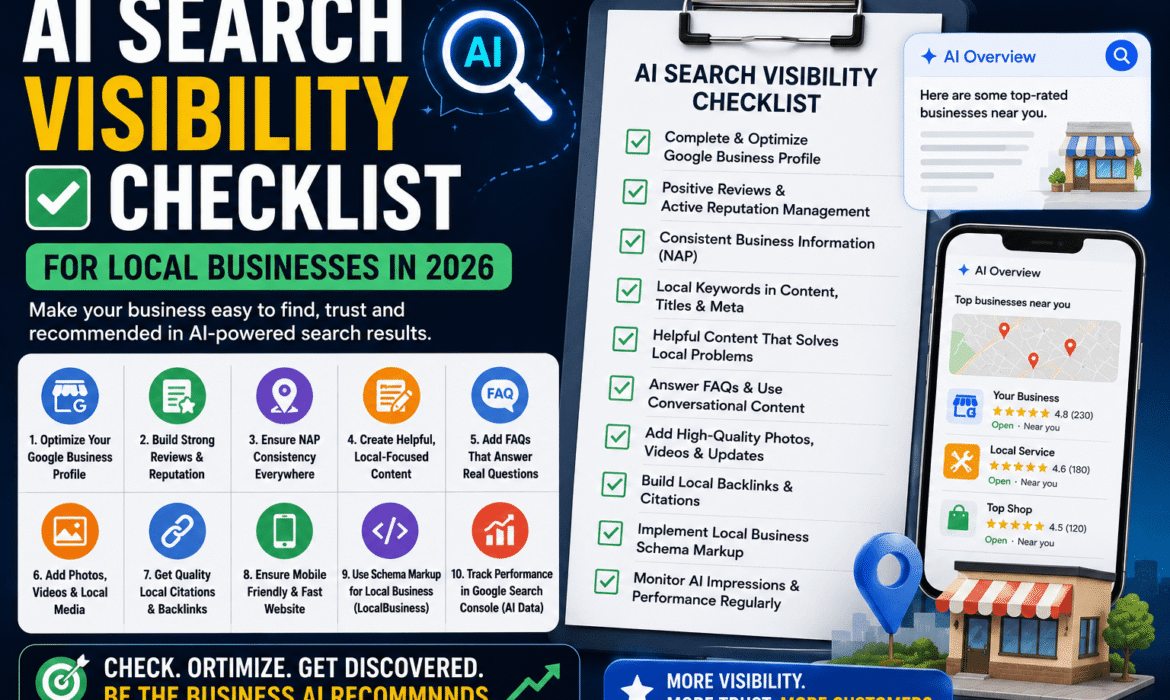
Understanding AI search is one thing. Actually doing something about it is another. If you’ve read up on AI Overviews, AI Mode, and Generative Engine Optimization but aren’t sure where to start, this checklist breaks it down into concrete, actionable steps. No theory here — just a practical AI search visibility checklist you can work through this month.
More people are asking AI tools directly for local recommendations — “best dentist near me,” “reliable plumber in my area,” “good coaching institute for class 12.” When AI assistants answer these questions, they pull from a specific set of signals: accurate business information, clear content, and consistency across the web. Businesses that haven’t set this up are simply invisible in these answers, regardless of how good their actual service is.
AI tools, particularly Google’s own AI Overviews and AI Mode, lean heavily on Google Business Profile data for local recommendations.
If your profile is getting views but not converting them into calls, our guide on getting more phone calls from Google Business Profile walks through this in more depth.
AI tools favor content that directly and clearly answers real questions, rather than vague, sales-heavy pages.
This is the core idea behind Generative Engine Optimization (GEO) — structuring content in a way that’s easy for AI tools to extract and cite accurately.
AI tools cross-reference information across multiple sources. Inconsistency creates doubt, which reduces the likelihood of your business getting recommended confidently.
AI tools tend to favor sources that demonstrate genuine credibility and expertise, not just keyword-optimized pages.
Even the best content won’t get surfaced if AI crawlers and search engines can’t access or understand your site properly.
You can’t improve what you’re not measuring, and AI search visibility now has real tracking tools behind it.
If you’ve worked through this checklist and still aren’t showing up where competitors are, the issue may run deeper than a single fix — often tied to overall content authority, site structure, or how established your online presence is. Our guide on why competitors appear in AI search while your business doesn’t covers the less obvious reasons this happens.
Working through a checklist is a great start, but turning it into consistent, ongoing visibility takes dedicated strategy and monitoring. Baba Advertisers’ digital advertising services help local businesses in Varanasi and beyond build and maintain AI search visibility alongside traditional SEO, so you’re not just checking boxes once, but staying visible as this landscape keeps evolving.
What’s the fastest way to improve AI search visibility for a local business? Starting with your Google Business Profile usually delivers the fastest impact, since AI tools rely heavily on it for local recommendations. Accurate, complete information there makes an immediate difference.
Do I need to rewrite my entire website for AI search? Not necessarily. Focus first on your most important pages — homepage, key service pages, and frequently asked questions — restructuring them to answer questions clearly and directly.
How is AI search optimization different from traditional SEO? Traditional SEO focuses on ranking in search results, while AI search optimization focuses on getting cited or referenced within AI-generated answers, which relies more heavily on clarity, consistency, and direct answers.
How often should I check my AI search visibility? Checking monthly is a reasonable starting point, since AI search features and how they surface information continue to evolve regularly.
Is this checklist relevant for every type of local business? Yes, the fundamentals — accurate business information, clear content, and consistency — apply across virtually every local business category, from healthcare to retail to professional services.
Related Reads:
Ready to actually act on this checklist? Talk to Baba Advertisers — we’ll help you build lasting AI search visibility for your business in 2026