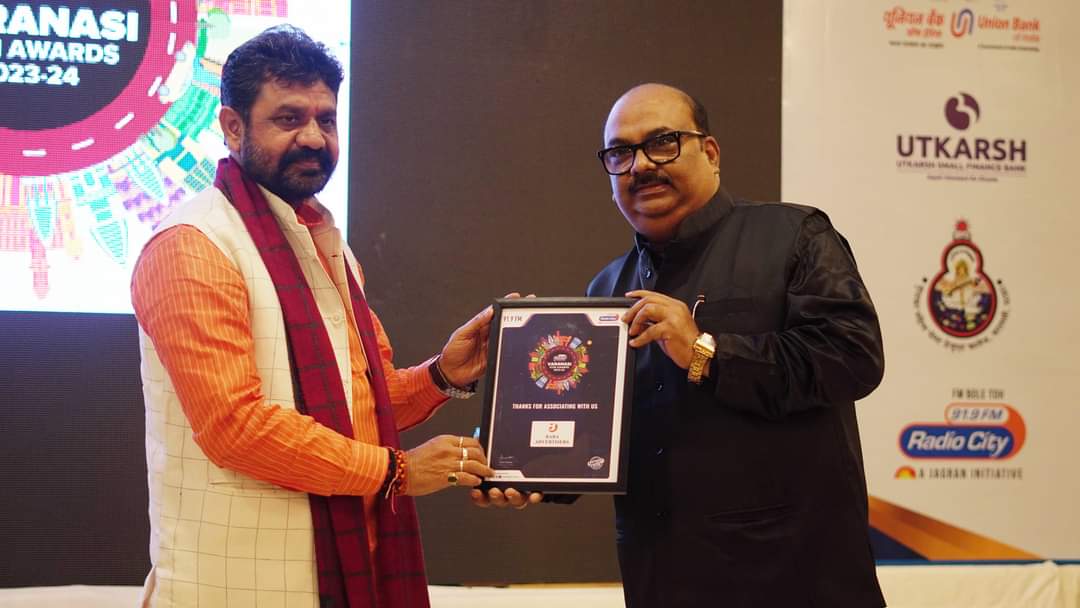

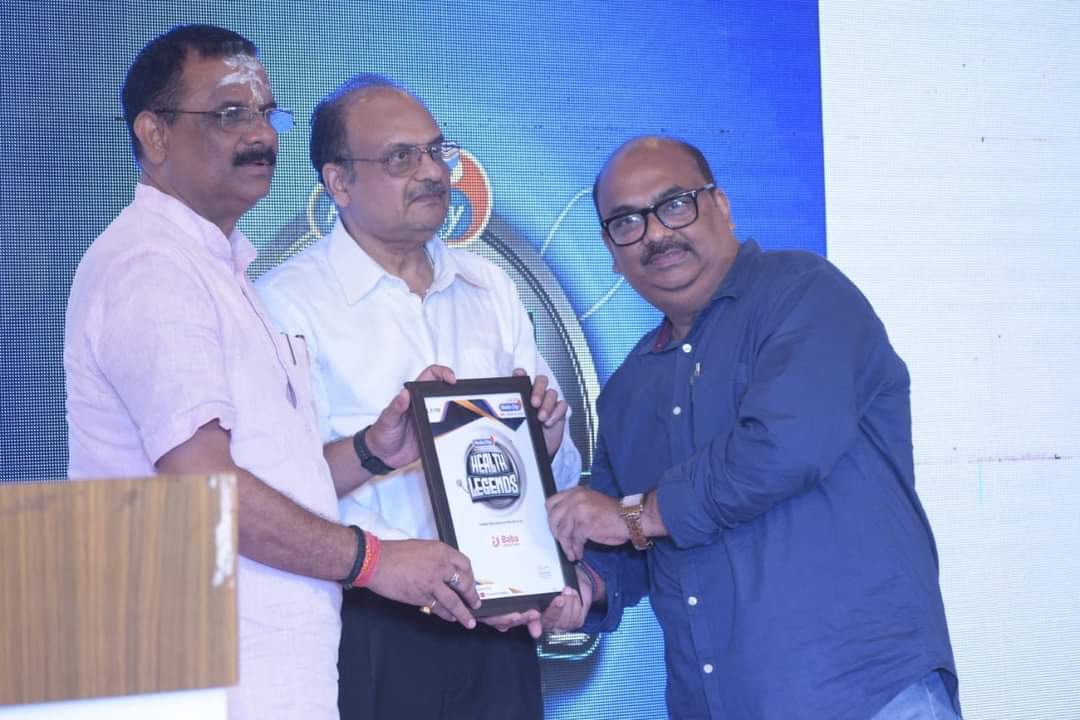
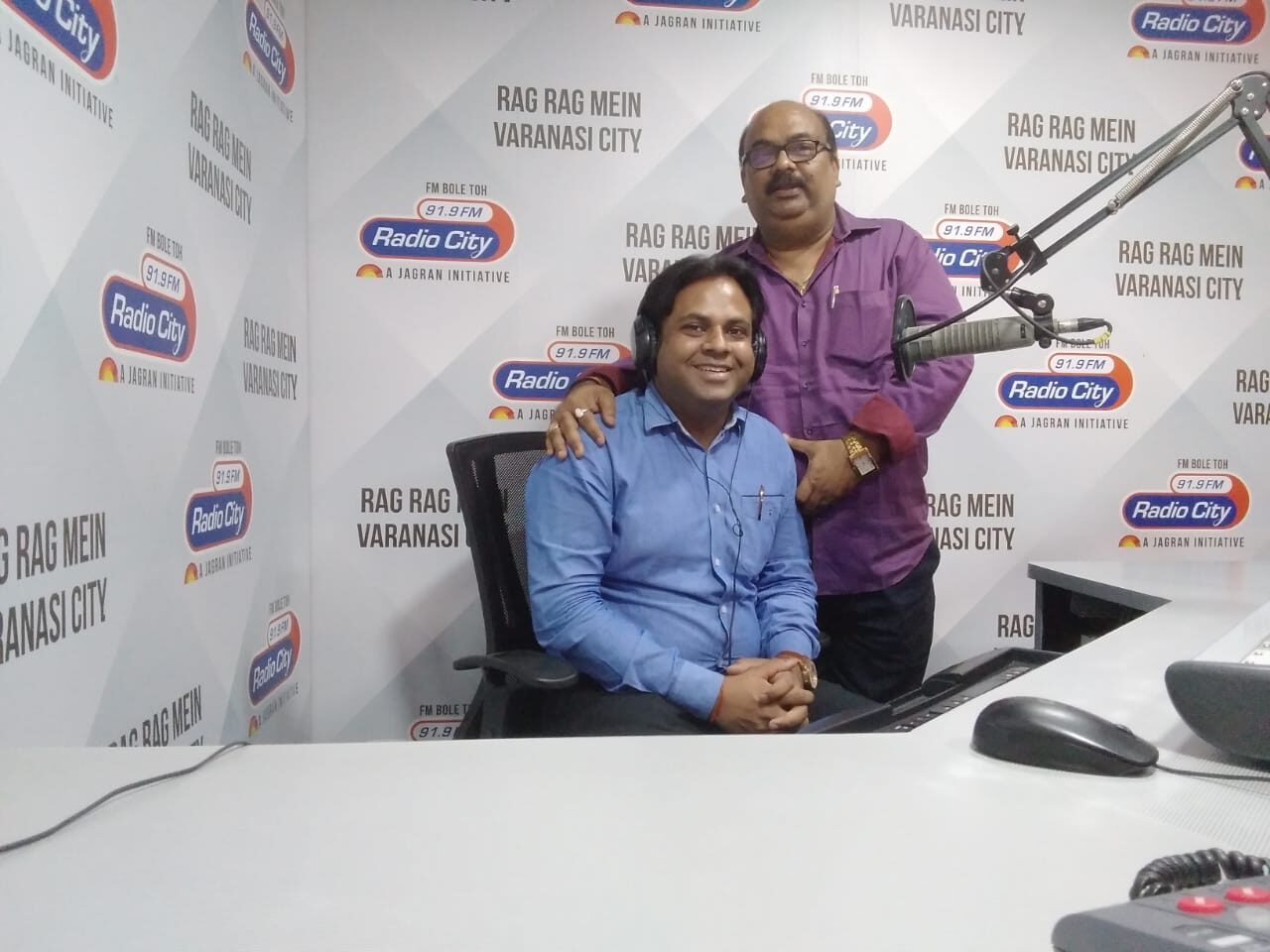

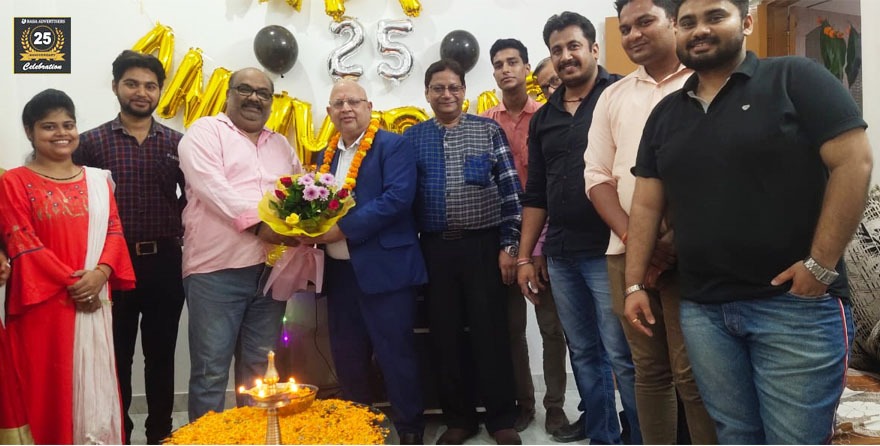

Based in Varanasi since 1997, BABA Advertisers is a leading advertising agency in Varanasi, India, with a rich legacy of driving remarkable sales for our clients through comprehensive digital advertising services.

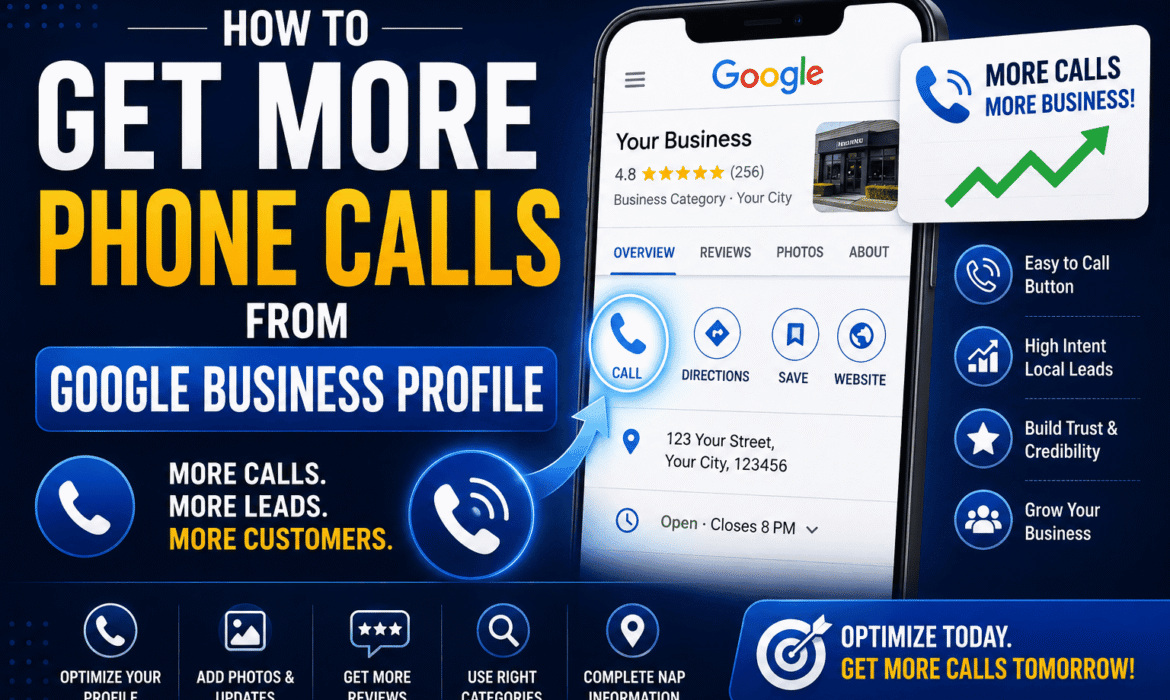
For most local businesses, a phone call is the single most valuable action someone can take on Google — it means they’re ready to talk, book, or buy right now. If you’re getting views on your profile but not enough phone calls from Google Business Profile, the good news is that this is almost always fixable with a few specific, practical changes. Here’s exactly what to focus on.
Website visits and profile views are useful, but a phone call signals real intent — someone has already decided you’re worth contacting. Optimizing specifically for calls, not just visibility, is one of the fastest ways to turn your Google presence into actual business. This builds directly on general Google Business Profile optimization, with a sharper focus on the call button itself.
This sounds obvious, but it’s one of the most common issues. Your phone number should:
Even small mismatches (different formatting, an old number still listed somewhere) can quietly cost you calls.
Google uses your business category to decide when and where to show your call button prominently, especially in local map searches. An overly broad or incorrect category can mean your business shows up for the wrong searches, or gets buried under more relevant competitors.
If your listed hours don’t match your actual hours, customers may avoid calling assuming you’re closed — or worse, call when you’re not available and never try again. Update holiday hours and special closures promptly, since Google actively prompts users with “closed now” or “open now” labels that directly affect call likelihood.
Profiles with genuine, recent photos of the business, staff, and work build more trust than generic or missing images — and trust is a major factor in whether someone picks up the phone to call a business they’ve never used before.
Reviews are one of the strongest trust signals on your entire profile. A steady stream of recent, positive reviews — especially ones you’ve responded to — reassures potential customers before they even call. Businesses with very few or outdated reviews often lose calls to competitors with a stronger review presence, even if the service quality is similar.
Regular Google Posts (offers, updates, announcements) keep your profile active and give people a reason to engage right now. Posts with a clear call-to-action, like “Call now for today’s availability,” can nudge someone from browsing to calling.
While messaging isn’t a call itself, it captures people who aren’t ready to call yet but want quick answers. Responding promptly to messages often leads directly to a phone call once basic questions are answered.
Your business description should clearly state what you do and who you serve, so people calling already have the right expectations. A vague description leads to mismatched enquiries or no calls at all, since visitors aren’t confident about what you actually offer.
Google Business Profile shows you how many calls your listing generated, and when. Reviewing this regularly helps you understand which days, posts, or changes actually moved the needle, so you can double down on what’s working.
Profiles with missing information — no website link, no service list, no attributes — appear less trustworthy and complete than fully filled-out competitors. A thorough profile signals a serious, active business, which quietly increases the likelihood someone picks up the phone.
If you’ve covered all of this and calls still aren’t coming in, the issue may be deeper — low visibility in local search results, strong competition nearby, or a profile that needs a full audit and rebuild. This is where Baba Advertisers’ Google Business Profile and digital advertising services come in, helping local businesses build a profile that’s not just visible, but actually converts views into calls.
Why is my Google Business Profile getting views but no calls? This usually points to trust or clarity issues — incomplete information, few reviews, outdated hours, or an unclear description can all stop someone from calling even if they’ve found your listing.
Does responding to reviews actually increase calls? Yes. Responding to reviews, especially recent ones, builds trust and signals an active, engaged business, which makes potential customers more comfortable calling.
How often should I post on Google Business Profile to get more calls? Posting weekly, or whenever you have a relevant update or offer, helps keep your profile active and gives people a fresh reason to take action.
Can I see how many calls my Google Business Profile is generating? Yes, Google Business Profile Insights shows you call data, including how many calls came from your listing over a given period.
What’s the fastest way to increase calls from my profile? Fixing your phone number consistency, updating hours, and actively collecting reviews usually deliver the fastest, most noticeable improvement in calls.
Related Reads:
Not getting enough calls from your Google Business Profile? Talk to Baba Advertisers — we’ll help optimize your listing to convert views into real enquiries.
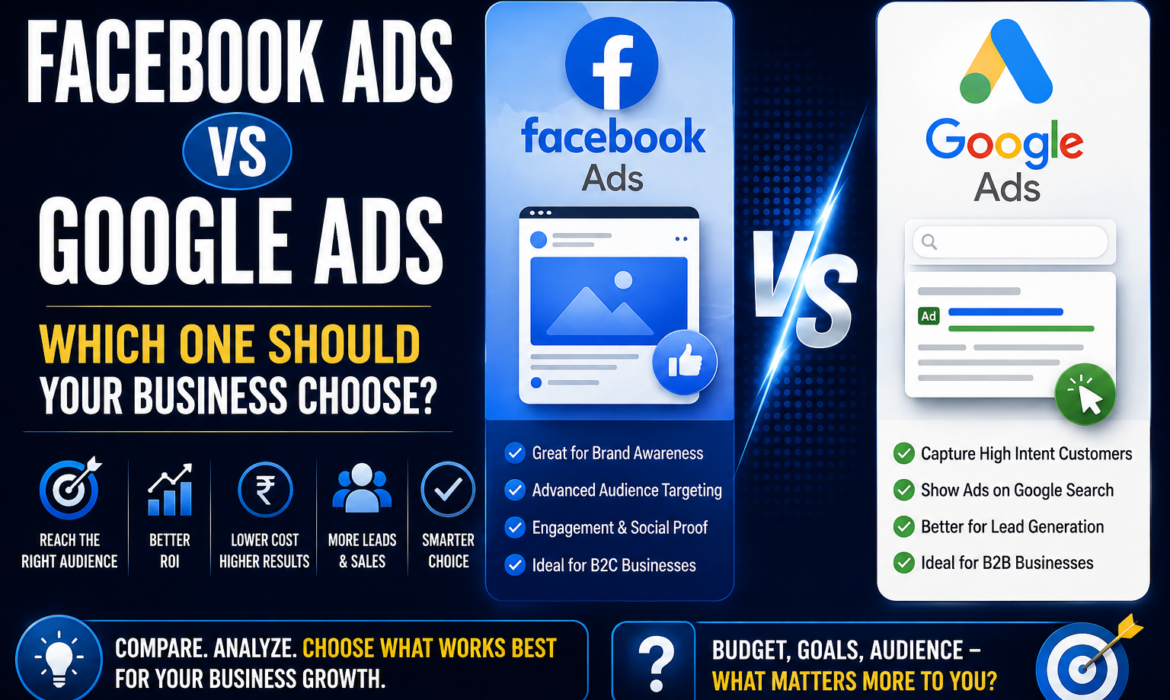
If you’ve got a limited marketing budget and are trying to decide between Facebook Ads vs Google Ads, you’re not alone — it’s one of the most common questions small business owners ask before spending their first rupee on digital advertising. The honest answer is that both platforms work well, but for different goals. This guide breaks down how each one actually works, what they’re best at, and how to decide which one deserves your budget first.
The biggest difference between these two platforms isn’t features — it’s intent.
This single difference shapes almost everything else about how the two platforms perform.
Google Ads places your business at the top of search results when someone types in a relevant keyword — like “best dentist near me” or “wedding photographer in Varanasi.” Because the person is already searching, Google Ads tends to capture people closer to making a decision.
Best for:
If you want a deeper breakdown of what this typically costs, our guide on Google Ads cost in India covers real pricing ranges by industry.
Facebook (and Instagram) Ads work differently — instead of waiting for someone to search, you’re placing your ad directly in front of people based on their interests, behavior, age, location, and more, while they’re scrolling their feed.
Best for:
| Factor | Google Ads | Facebook Ads |
|---|---|---|
| User Intent | High — actively searching | Low to medium — passive scrolling |
| Best For | Direct leads, local services | Brand awareness, visual products |
| Targeting | Keyword-based | Interest, behavior, demographic-based |
| Cost Structure | Generally higher CPC | Generally lower cost per impression |
| Visual Format | Mostly text-based | Highly visual (image/video) |
| Speed to Results | Faster for direct conversions | Slower, builds over time |
| Ideal for | Clinics, lawyers, real estate, urgent services | Retail, fashion, restaurants, events |
Yes — and for many businesses, this is actually the smartest approach rather than choosing one over the other. A common, effective strategy is:
This combined approach often performs better than relying on a single channel, especially for businesses trying to generate consistent leads online. For a deeper look at blending both, our earlier guide on Google Ads vs social media ads covers additional platform-specific nuances worth knowing.
Ask yourself these three questions:
Choosing between Facebook Ads and Google Ads isn’t a one-size-fits-all decision — it depends on your industry, budget, and goals. Baba Advertisers’ digital advertising services help small businesses figure out the right platform mix and manage campaigns that are optimized for actual leads and results, not just clicks or reach.
Which is better, Facebook Ads or Google Ads? Neither is universally better — Google Ads works best for high-intent searches, while Facebook Ads works best for visual products and brand awareness. The right choice depends on your business and goals.
Is Facebook Ads cheaper than Google Ads? Generally, yes, in terms of cost per impression, but Google Ads often delivers higher-intent leads that convert faster despite the higher cost per click.
Can a small business run both Facebook Ads and Google Ads? Yes, and combining both is often more effective — Facebook builds awareness while Google captures people who are ready to act.
Which platform is better for local businesses? Google Ads is usually stronger for local services people actively search for, like clinics or repair services, while Facebook Ads works well for local businesses with strong visual appeal, like restaurants or salons.
How do I know which platform is working for my business? Tracking where actual enquiries and conversions come from — not just clicks or impressions — is the only reliable way to know which platform is delivering real results for your business.
Related Reads:
Not sure which platform is right for your business? Talk to Baba Advertisers — we’ll help you choose and manage the ad strategy that actually converts.
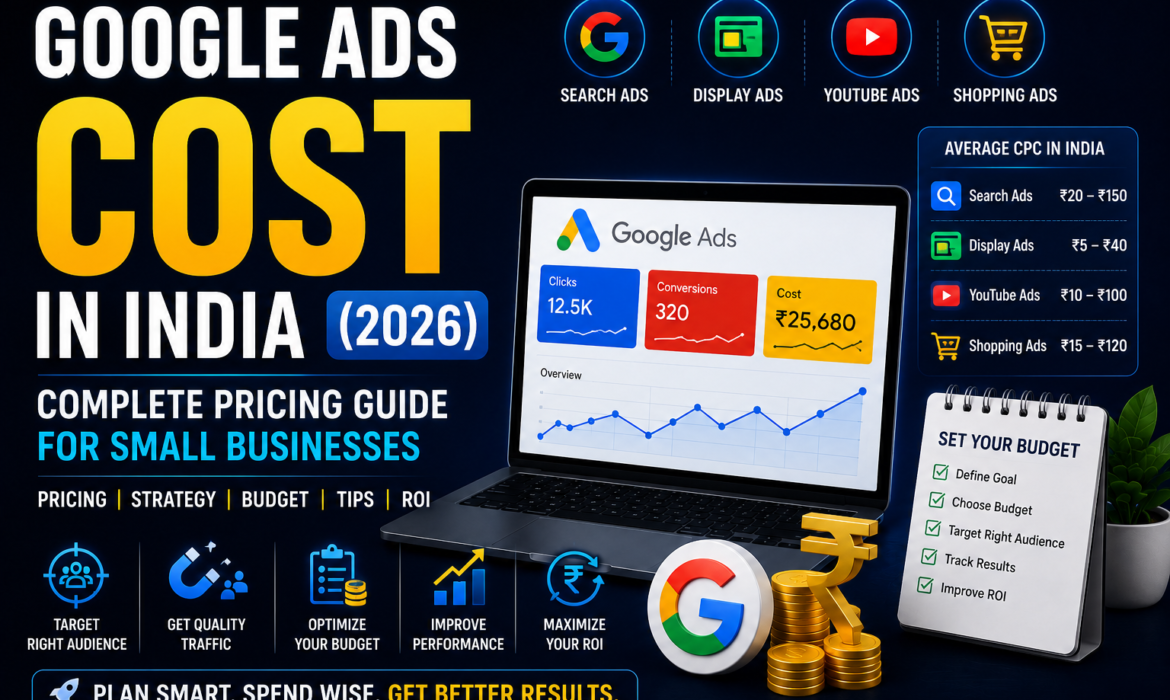
One of the first questions every small business owner asks before running their first campaign is simple: what does Google Ads actually cost? The honest answer is — it depends. Google Ads cost in India varies widely based on your industry, competition, location, and campaign goals. This guide breaks down real pricing ranges, what affects your costs, and how to budget smartly whether you’re just starting out or scaling up.
Google Ads doesn’t have a fixed price tag. Instead, you set a budget and bid in an auction against other businesses targeting the same keywords or audience. You’re typically charged in one of these ways:
Your daily or monthly budget acts as a cap — Google won’t spend beyond what you set, giving small businesses control over exact spending.
| Industry | Average CPC (₹) |
|---|---|
| Healthcare & Clinics | ₹15 – ₹45 |
| Real Estate | ₹20 – ₹60 |
| Education & Coaching | ₹10 – ₹35 |
| Legal Services | ₹30 – ₹80 |
| E-commerce & Retail | ₹8 – ₹25 |
| Local Services (Plumber, Salon, etc.) | ₹5 – ₹20 |
| Travel & Hospitality | ₹10 – ₹40 |
| B2B & Consulting | ₹25 – ₹70 |
These are approximate ranges and can shift based on location, competition, and seasonal demand — always treat them as a starting reference, not a fixed quote.
Highly competitive industries like legal services and real estate see higher CPCs because more businesses are bidding for the same keywords.
Broad, high-demand keywords cost more than specific, long-tail keywords. For example, “lawyer” will cost significantly more per click than “property dispute lawyer in Varanasi.”
Advertising in metro cities like Mumbai or Delhi typically costs more than targeting Tier 2 and Tier 3 cities, where competition is lower.
Google rewards ads with better relevance, landing page experience, and expected click-through rate with lower costs per click — meaning a well-optimized campaign can cost less than a poorly built one, even at the same bid.
Search campaigns aimed at direct conversions often cost more per click than Display or brand-awareness campaigns, since search intent is stronger and more competitive.
Costs typically rise during festive seasons, exam periods (for education), or wedding season (for related businesses), when more advertisers are bidding for the same audience.
There’s no universal number, but here’s a practical starting range for small businesses in India:
The right budget depends on your goals, profit margins, and how much a single customer is worth to your business — a higher-ticket service can usually justify a higher cost per click.
Many businesses see the best return by combining channels rather than relying on one — a comparison worth reading if you’re deciding between Google Ads and social media ads for your specific business.
For most small businesses, yes — provided the campaign is set up with a clear strategy, proper targeting, and a conversion-focused website. The mistake many businesses make is expecting Google Ads to work in isolation, without a system to actually generate and convert leads once someone clicks the ad. Ad spend without a strong landing experience often means paying for clicks that never turn into customers.
Setting up a campaign is easy — managing it profitably is where most small businesses struggle. Bid strategies, keyword research, negative keywords, and ongoing optimization all affect how far your budget actually goes. Baba Advertisers’ digital advertising services help small businesses in Varanasi and beyond build Google Ads campaigns that are budgeted realistically and optimized continuously for actual leads, not just clicks.
How much does Google Ads cost per month in India for a small business? Most small businesses start with ₹10,000–₹50,000 per month, depending on industry, competition, and goals, and scale up based on results.
What is the average CPC for Google Ads in India? It varies widely by industry, typically ranging from ₹5 to ₹80 per click, with competitive sectors like legal and real estate on the higher end.
Is Google Ads more expensive than social media ads? Google Ads generally has a higher cost per click due to stronger search intent, while social media ads often cost less per impression but may need more volume to convert.
Can I set a fixed daily budget for Google Ads? Yes, Google Ads lets you set a daily or monthly budget cap, so you never spend more than what you’ve allocated.
Do I need an agency to manage Google Ads, or can I do it myself? You can run campaigns yourself, but without expertise in bidding, keyword research, and optimization, many small businesses end up overspending for underwhelming results — which is where professional management often pays for itself.
Related Reads:
Not sure what Google Ads budget makes sense for your business? Talk to Baba Advertisers — we’ll build a campaign that’s budgeted right and optimized to convert.
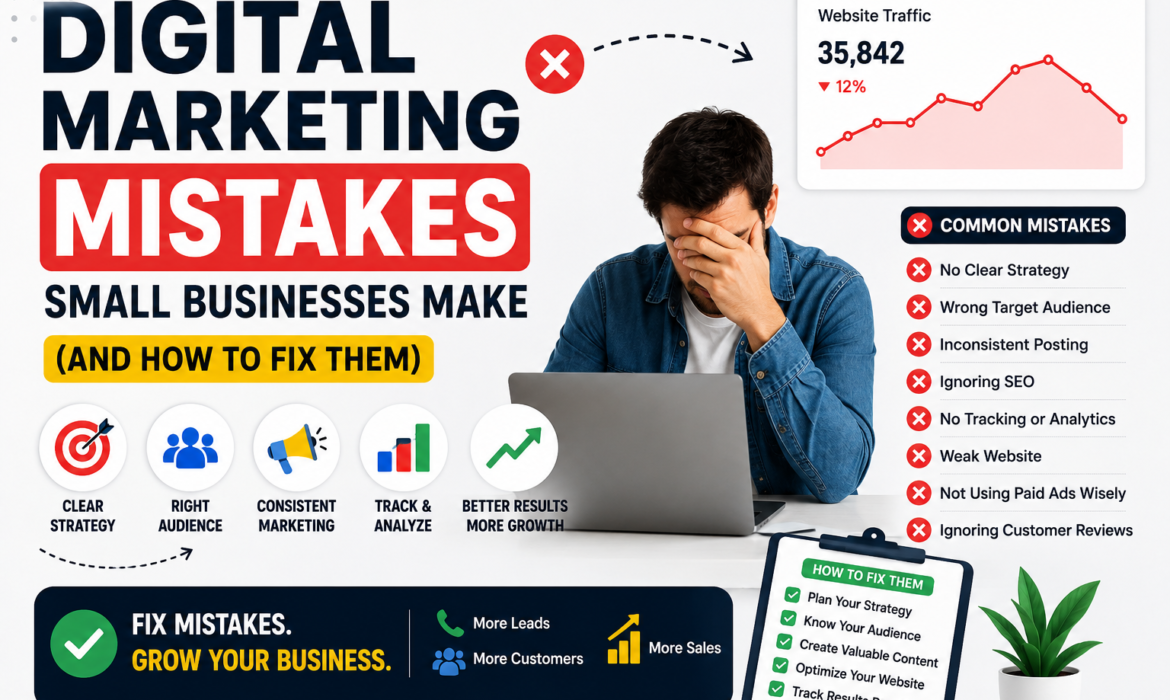
Running ads, posting on Instagram, and showing up in Google search feels like enough — until months go by and the phone still isn’t ringing. The truth is, most of the digital marketing mistakes small businesses make aren’t about effort, they’re about direction. Spending money and time in the wrong places, without a clear strategy, quietly drains budgets while competitors pull ahead. Here’s a breakdown of the most common mistakes, and what to do instead.
Many small businesses jump straight into boosting posts or running Google Ads without first defining who they’re targeting, what result they want, or how they’ll measure success. Random spending without a plan usually produces random, disappointing results. A proper strategy — audience, budget, message, and goal — should always come before the first rupee is spent.
A huge number of local customers search for businesses on Google Maps before anywhere else. Yet many small businesses either haven’t claimed their Google Business Profile or leave it incomplete — no photos, no reviews, outdated hours. This is one of the fastest, cheapest ways to get found locally, and skipping it means losing customers who were already looking for you.
SEO isn’t something you do once and forget. Search algorithms change constantly, and competitors are actively working on their own rankings. Businesses that set up their website once and never revisit their SEO strategy often find themselves slipping down the results page without knowing why. It’s worth understanding why some businesses stay invisible on Google despite having a website.
Search behaviour has shifted — people now ask ChatGPT, Gemini, and Perplexity for recommendations, not just Google. Businesses that haven’t adapted their content and online presence for AI search are increasingly missing out on a growing share of enquiries. If you’ve noticed competitors showing up in AI search results while you don’t, this is likely the reason.
Posting inconsistently, or posting content that doesn’t align with what your audience actually wants to see, rarely builds real engagement. Social media works best with a clear content plan — consistent posting, a defined tone, and content built around what converts followers into actual customers, not just likes.
A large follower count looks good, but it doesn’t pay the bills. Many small businesses chase vanity metrics like likes and followers while ignoring whether their Instagram is actually generating enquiries. The real question should always be: how many of these followers are turning into paying customers?
Relying entirely on one platform — whether it’s just Facebook ads, just SEO, or just newspaper ads — leaves a business vulnerable and limits reach. A combination of channels, tailored to where your specific audience spends their time, almost always performs better than putting all your budget into one basket. Comparing options like Google Ads vs social media ads is a good starting point.
Running campaigns without tracking where enquiries actually come from makes it impossible to know what’s working. Many small businesses can’t say which platform, ad, or post brought in their last five customers — which means they can’t repeat what worked or cut what didn’t.
Traffic doesn’t equal business. A website that looks nice but doesn’t guide visitors toward calling, messaging, or filling a form is a missed opportunity every single day. Getting traffic is only half the job — converting that traffic into real enquiries is the other, often overlooked, half.
Digital marketing, especially SEO and content-based strategies, takes consistent effort over weeks and months to show real results. Businesses that give up after two or three weeks — or constantly switch strategies — rarely see the compounding results that come from staying consistent with a well-planned approach.
If you’ve tried managing digital marketing on your own and results still aren’t matching the effort, it’s often a sign that a structured, expert-led strategy is what’s missing — not more spending. This is exactly where Baba Advertisers’ digital advertising services come in, combining SEO, social media, Google Business Profile optimization, and AI search readiness into one strategy built around actual business growth, not just visibility.
What is the most common digital marketing mistake small businesses make? Spending on ads or social media without a clear strategy is one of the most common and costly mistakes, since it leads to random results that are hard to measure or improve.
How important is Google Business Profile for small businesses? Very important — it’s often the first thing potential local customers see, and an incomplete or unclaimed profile means losing customers who are already searching for your business.
Do small businesses need to worry about AI search? Yes. As more people use tools like ChatGPT and Gemini to find recommendations, businesses that haven’t optimized for AI search are increasingly missing out on visibility.
How long does digital marketing take to show results? Most strategies, especially SEO and content-based approaches, need consistent effort over several weeks to months before showing meaningful, compounding results.
Should a small business handle digital marketing on its own or hire an agency? It depends on time, expertise, and budget — but businesses struggling to see results often benefit from an experienced agency that can build and manage a structured strategy across multiple channels.
Related Reads:
Making some of these mistakes without realizing it? Talk to Baba Advertisers — we’ll help you build a digital marketing strategy that actually converts.
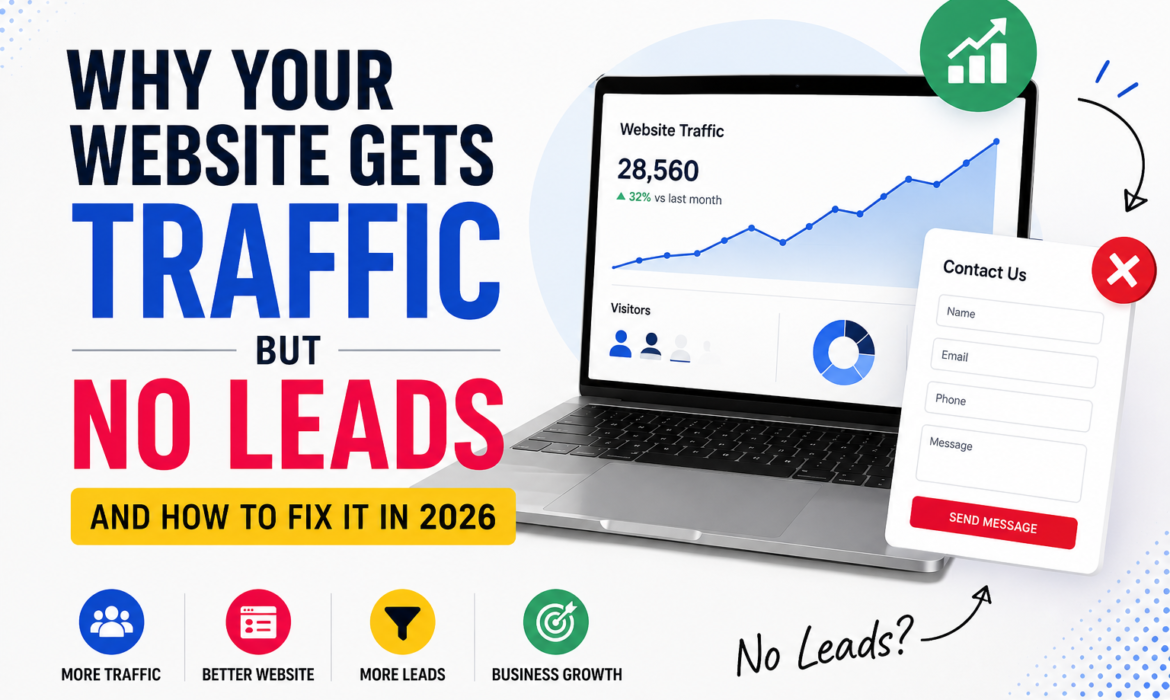
You check Google Analytics and the numbers look decent — hundreds of visitors every month. But your phone isn’t ringing, your enquiry form sits empty, and your WhatsApp isn’t buzzing with new leads. If your website gets traffic but no leads, the problem isn’t visibility — it’s what happens after someone lands on your page. In this guide, we’ll break down the real reasons traffic isn’t converting, and what to fix first to turn visitors into paying customers.
Many business owners assume more traffic automatically means more business. It doesn’t. Traffic tells you people are finding your website. Leads tell you people trust it enough to take the next step — call, message, or fill a form. A website can rank well, get shared on social media, and still fail to convert a single visitor if it doesn’t guide people toward action. Getting your Google Business Profile optimized or your SEO ranking up is only half the job — the other half is what visitors experience once they arrive.
If a visitor can’t tell within 5 seconds what you offer and why they should choose you, they’ll leave. Vague headlines like “Welcome to Our Company” waste the most valuable space on your page. Your homepage should say exactly what you do, for whom, and why it matters — immediately.
A lot of websites list services beautifully but never actually ask the visitor to do anything. No “Book a Free Consultation,” no “Get a Quote,” no visible phone number. Every page should have one clear next step, not five competing options.
Every extra second a page takes to load pushes visitors away, especially on mobile. Most people browsing from their phone in India won’t wait around for a slow site — they’ll bounce straight to a competitor.
If your site is hard to navigate, or your enquiry form is broken, on a phone, you’re losing the majority of your traffic before they even see your offer. Most Indian users search and browse on mobile first.
Traffic that isn’t relevant will never convert, no matter how good your website looks. If your ads or SEO are pulling in people who aren’t actually looking for what you sell, you’ll see high visitor counts and zero enquiries. This is a common issue when SEO and paid campaigns aren’t aligned with actual buyer intent.
New visitors don’t know you yet. Without reviews, testimonials, certifications, or real photos of your work, people hesitate to hand over their contact details. Trust is what turns a curious visitor into an enquiry.
Long forms asking for excessive detail scare people away. The easier it is to reach you — a short form, a click-to-call button, a WhatsApp chat — the more likely someone is to actually follow through.
Sometimes leads are technically happening — but they’re falling through the cracks because there’s no system tracking enquiries, missed calls, or form submissions. A lead that isn’t followed up within minutes or hours often goes cold.
Businesses that combine strong Google Business Profile visibility with a website built to convert see a very different result from those relying on traffic numbers alone.
If you’ve tried tweaking your website yourself and traffic still isn’t turning into enquiries, it’s often a sign of a deeper structural issue — not something a small edit will fix. You should consider bringing in a digital marketing team if:
This is exactly where Baba Advertisers’ digital advertising and SEO services come in — combining traffic generation with a website and campaign strategy actually built to convert visitors into paying customers.
Traffic without leads is a leaking bucket — you’re spending effort (and often ad budget) to bring people to your website, only to lose them before they take action. The fix isn’t always “get more traffic.” Often, it’s fixing what happens after someone arrives: your messaging, your speed, your trust signals, and how easy you make it to reach you.
Why does my website get traffic but no leads? Usually because visitors don’t find a clear reason to act — this can be due to unclear messaging, a weak call-to-action, slow loading speed, or a website that isn’t optimized for mobile users.
How can I convert more website visitors into leads? Focus on a clear value proposition, a strong visible CTA, fast page speed, real trust signals like reviews, and a short, easy contact form.
Is more traffic the solution to fewer leads? Not always. If your website isn’t built to convert, more traffic often just means more people leaving without taking action. Fixing conversion issues first usually delivers better results than simply increasing traffic.
How long does it take to fix a low-converting website? Small fixes like improving your CTA or shortening forms can show results within weeks. Larger issues like site speed or messaging usually need a proper audit and redesign strategy.
Who can help me fix my website’s conversion problem? A digital marketing agency experienced in both traffic generation and conversion optimization, like Baba Advertisers, can audit your website and identify exactly where visitors are dropping off.
Related Reads:
Getting traffic but not enough enquiries? Talk to Baba Advertisers — we’ll help you turn visitors into real, paying customers.
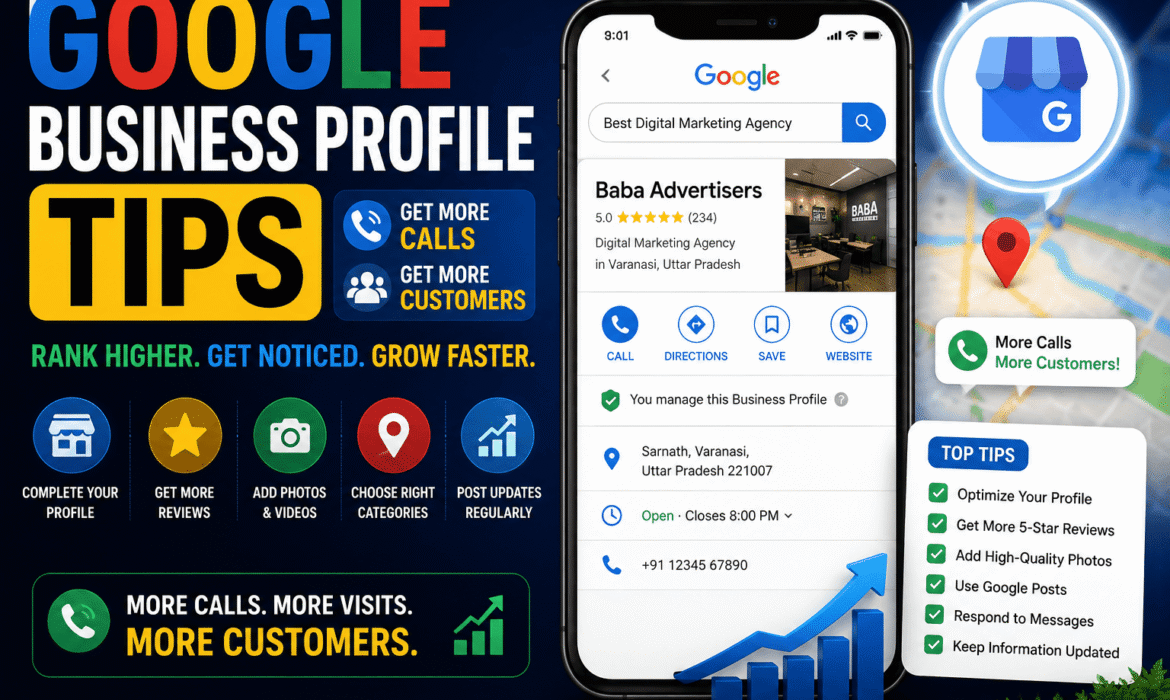
Your Google Business Profile is the most powerful free marketing tool available to any local Indian business right now. When someone searches “advertising agency in Varanasi” or “best [your service] near me” — your Business Profile is what determines whether they call you, visit your website, or choose your competitor instead.
Yet most Indian businesses set up their profile once and never touch it again. Moreover, these same businesses wonder why competitors consistently get more calls, more walk-ins, and more inquiries from Google.
These Google Business Profile tips will change that. Moreover, every tip in this guide is free, implementable today, and produces measurable results within weeks.
The most impactful Google Business Profile tips for getting more calls and customers are: completing every profile field with specific factual information, posting weekly updates, collecting 2 to 3 new detailed reviews every month, responding to every review within 24 hours, uploading fresh photos monthly, and adding every individual service with its own description. Together, these actions signal active, trustworthy operation to Google — producing dramatically more calls, clicks, and customer visits.
Google Business Profile is no longer just a map listing. In 2026, it serves three critical functions simultaneously.
First — it determines whether your business appears in Google’s local map pack — the three businesses shown at the very top of local search results. Moreover, this position generates more clicks than most websites receive from organic search alone.
Second — it feeds directly into Google AI Overviews and Gemini. When someone asks Google AI “which advertising agency in Varanasi handles newspaper bookings?” — Google’s AI pulls from Business Profile data to construct its answer. Furthermore, an incomplete or inactive profile is completely invisible in these AI-generated responses.
Third — it is where customers form their first impression of your business. Consequently, the completeness, activity level, and review quality of your profile directly determines how many potential customers choose to contact you versus choosing a competitor.
Before implementing any tips, check your current profile status:
☐ Business name exactly matches your legal business name
☐ Primary category is the most specific option available
☐ Address complete and identical to your website
☐ Phone number correct and active
☐ Website URL linked and working
☐ Business hours accurate — including Saturday and Sunday
☐ Business description written — at least 250 words
☐ At least 10 photos uploaded
☐ At least 10 Google reviews received
☐ Posted an update within the last 7 days
☐ All services listed individually with descriptions
☐ Responded to every existing review
Score your business: Every unchecked item is a direct reason customers are choosing your competitors over you on Google. Moreover, each fix produces measurable improvement in calls and profile visits within 2 to 4 weeks.
Your primary business category is the single most important field in your entire Google Business Profile. Google uses this category to decide when your business is relevant to a search query — and an incorrect or vague category excludes you from entire categories of customer searches.
Moreover, many businesses choose a broad category when a more specific one exists. An advertising agency should not select “Marketing Agency” when “Advertising Agency” is available. A newspaper ad booking service should not select “Business Service” when “Advertising Agency” is the correct match.
What to do:
Log into your profile and check your primary category. Search for the most specific option that accurately describes your core business. Furthermore, add three to five secondary categories covering every other service you offer — digital marketing, outdoor advertising, radio advertising, and so on. Consequently, each secondary category opens your profile to additional search queries your competitors may be missing.
Most businesses write a description full of vague, marketing-heavy phrases — “We are a leading provider of quality advertising solutions.” This gives Google nothing specific to work with and gives potential customers no reason to choose you.
Moreover, in 2026, your business description feeds directly into Google AI recommendations. AI tools extract specific, factual information from descriptions — and ignore vague marketing language entirely.
What to do:
Rewrite your description as a clear, factual, 250 to 300 word paragraph covering four things — what you do specifically, where you operate, how long you have been in business, and what makes you the right choice. Furthermore, include your most important service keywords naturally — not as a list, but woven into readable sentences.
For example: “Baba Advertisers is a full-service advertising agency in Varanasi, established in 1997 with over 28 years of experience. We provide newspaper advertising across all major publications — Dainik Jagran, Hindustan, Amar Ujala, and Times of India — as well as digital marketing campaigns, outdoor hoarding placements, and radio and TV advertising across Uttar Pradesh. Trusted by hundreds of businesses across Varanasi…”
The Services section is one of the most underused features on Google Business Profile. Most businesses list two or three generic service names without any descriptions. Moreover, Google uses service data to answer highly specific customer queries — “Does this agency handle radio ad bookings?” or “Can they place ads in Dainik Jagran?”
What to do:
Add every individual service as a separate entry. Write a two to three sentence description for each one — covering what it includes, who it serves, and what outcome it delivers. Furthermore, include your city name naturally in at least two or three service descriptions to reinforce local relevance.
At Baba Advertisers, our digital marketing team helps businesses optimise their complete Google Business Profile — from category selection and service descriptions to photo strategy and review management.
Google rewards profiles with recent, high-quality photos — because photo activity signals active, ongoing operation. Moreover, profiles with more photos consistently receive more profile views and direction requests than those with outdated or no images.
Furthermore, in 2026, Google AI tools assess photo recency as part of their business credibility assessment — making monthly uploads an AI visibility strategy as much as a local SEO one.
What to do:
Upload a minimum of four to six new photos every month. Cover different categories — exterior shots showing your signage, interior shots showing your workspace, team photos showing real people, and work samples showing completed projects. Moreover, name your image files descriptively before uploading — “newspaper-advertising-varanasi-baba-advertisers.jpg” — because Google reads file names alongside image content.
Google Business Posts — short updates published directly to your profile — are one of the most consistently underused features available. Moreover, businesses that post weekly consistently outperform non-posting competitors in local search visibility — because posting frequency signals active operation to Google’s ranking systems.
Furthermore, Google Posts appear directly in your Business Profile — giving potential customers additional content to engage with before deciding to call.
What to do:
Publish one post every week — minimum. Effective post types include current offers and promotions, new service announcements, client success highlights, industry tips, and local community involvement. Moreover, write each post in natural, conversational language — and include a clear call to action in every single one.
Reviews are the most powerful trust signal on Google Business Profile — and one of the strongest signals Google uses to rank local businesses. Moreover, in 2026, AI tools read review content directly when generating local business recommendations — making detailed, specific reviews doubly valuable.
What to do:
Implement a systematic review collection process — not an ad hoc one. After every completed service, send a WhatsApp message to the client with a direct link to your Google review page. Moreover, ask them specifically to mention the service they received and the city — because specific reviews carry significantly more AI visibility value than generic ones.
Furthermore, aim for two to three new reviews every month consistently — rather than a burst of reviews followed by months of silence. Google rewards consistent review flow over irregular spikes.
Review response rate is a direct ranking signal for Google Business Profile. Moreover, businesses that respond to every review — positive and negative — consistently rank higher in local search results than those that ignore reviews.
Furthermore, Google AI tools treat review response rate as a professionalism signal — using it when deciding which businesses to recommend in AI-generated answers.
What to do:
Set a rule — respond to every new review within 24 hours without exception. For positive reviews, thank the customer specifically and mention the service they used. For negative reviews, acknowledge the concern professionally, apologise without admitting specific fault, and invite the customer to contact you directly.
Moreover, include your business name and location naturally in your responses — because this text becomes searchable content that Google indexes alongside your reviews.
The Questions and Answers section of your Google Business Profile is directly scraped by Google AI when generating responses to customer queries about your business. Moreover, most businesses leave this section completely empty — losing a significant AI visibility opportunity.
What to do:
Proactively add your own questions and answer them yourself. Do not wait for customers to ask. Cover the most common pre-contact questions — your services, pricing approach, experience, geographic coverage, and booking process. Furthermore, monitor this section weekly and answer any new customer questions within 24 hours.
Inaccurate business hours are one of the fastest ways to lose customer trust — and damage your profile’s reliability signals with Google. When customers arrive at your business during listed hours and find it closed, they frequently leave negative reviews and report incorrect information to Google.
Moreover, Google flags profiles with reported inaccuracies — which directly reduces their local search visibility.
What to do:
Review your hours monthly. Update them immediately whenever they change — for festivals, holidays, special events, or seasonal variations. Furthermore, use Google’s special hours feature for public holidays — adding holiday hours proactively rather than leaving your regular hours displayed during closures.
Many service businesses overlook the Products section — assuming it applies only to retail shops. However, Google allows service businesses to add individual services as “products” with photos, descriptions, and prices. Moreover, these product listings appear prominently in mobile searches — capturing additional profile real estate that competitors without products are missing entirely.
What to do:
Add your most important services as individual product entries — complete with a specific photo, a clear description, and where possible, a price range. Furthermore, link each product to its corresponding website service page — giving interested customers a direct path to more detailed information.
Google Business Profile allows businesses to add a booking or appointment link directly to their profile — enabling customers to take action without ever visiting your website. Moreover, profiles with direct booking links consistently receive higher click-through rates than those requiring customers to navigate to a website first.
What to do:
Add your contact page URL, WhatsApp link, or any booking system link to the appointment booking field. Furthermore, ensure the linked page is mobile-optimised and loads in under three seconds — because most Google profile visitors are on mobile devices with variable connection speeds.
Google Business Profile provides detailed insights — showing how many people viewed your profile, clicked your website, called your number, and requested directions. Moreover, this data tells you exactly which profile elements are working and which need improvement.
What to do:
Check your insights every week. Pay particular attention to which search queries bring customers to your profile — these tell you exactly which keywords your customers use. Furthermore, track call volume week over week — so you can correlate spikes in calls with specific profile changes or posts. Consequently, this data-driven approach allows you to continuously improve your profile based on actual customer behaviour rather than guesswork.
| 🔴 Myth | 🟢 Fact |
|---|---|
| “Setting up Google Business Profile once is enough” | Google rewards active, regularly updated profiles — inactivity directly reduces visibility |
| “More reviews always means better ranking” | Review quality and recency matter as much as quantity — two recent detailed reviews outperform ten old generic ones |
| “Only the category and address matter” | Every field — description, services, photos, hours, Q&A — contributes to ranking and conversion |
| “Negative reviews will destroy my profile” | Professional responses to negative reviews often convert concerned searchers into customers |
| “Google Business Profile only affects map rankings” | In 2026, it directly influences Google AI Overview and Gemini recommendations — far beyond the map pack |
| “I don’t need photos — customers care about service not images” | Profiles with photos receive 42 percent more direction requests and 35 percent more website clicks than those without |
How do I get more calls from Google Business Profile?
Get more calls by completing every profile field, posting weekly updates, collecting two to three new detailed reviews monthly, responding to every review within 24 hours, uploading fresh photos every month, adding every service individually with descriptions, and keeping business hours perfectly accurate. Moreover, enabling the call button and adding a WhatsApp link to your profile directly increases call volume by reducing friction.
Does posting on Google Business Profile help with ranking?
Yes — significantly. Google treats posting frequency as an activity signal — rewarding businesses that post regularly with higher visibility in local search results. Moreover, posts directly appear in your Business Profile — giving searchers additional reasons to choose your business over non-posting competitors. Furthermore, consistent posting signals ongoing operation and trustworthiness to both Google and potential customers.
How many photos should I have on Google Business Profile?
Upload at least 10 photos to start — covering exterior, interior, team, and work samples. Moreover, add four to six new photos every month to maintain photo recency signals. Furthermore, profiles with more than 100 photos receive significantly more profile views than those with fewer than 10 — making consistent monthly uploads one of the highest-ROI profile optimisation activities available.
How do I respond to negative reviews on Google Business Profile?
Respond promptly — within 24 hours — professionally and empathetically. Acknowledge the concern without admitting specific fault. Apologise for the experience and invite the customer to contact you directly to resolve the issue. Moreover, keep responses brief and factual — never argue, make excuses, or attack the reviewer publicly. Consequently, a professionally managed negative review often builds more trust with potential customers than a universally positive review history.
Can Google Business Profile help my business appear in ChatGPT recommendations?
Yes — ChatGPT with browsing capability, Google Gemini, and Google AI Overviews all draw from Google Business Profile data when generating local business recommendations. Moreover, a complete, active profile with specific service descriptions, detailed reviews, and regular posts gives AI tools the factual data they need to confidently recommend your business. Consequently, Google Business Profile optimisation is simultaneously a local SEO and AI search visibility strategy in 2026.
Immediately — because every day with an incomplete or inactive profile is a day your competitors are capturing customers who searched for exactly what you offer.
Start today if:
Furthermore, Google Business Profile optimisation produces results significantly faster than most other digital marketing strategies — with measurable improvements in calls and profile visits typically visible within two to four weeks of consistent implementation.
What are the most important Google Business Profile tips for getting more calls?
The most impactful tips are completing your business description with specific factual content, adding every service individually, collecting two to three new detailed reviews monthly, responding to every review within 24 hours, posting weekly updates, and uploading fresh photos every month. Together, these actions signal active, trustworthy operation — the primary factor Google uses to determine which businesses to show most prominently in local search results.
How often should I update my Google Business Profile?
Post a weekly update minimum. Upload new photos at least monthly. Respond to new reviews within 24 hours. Review all profile fields monthly for accuracy — particularly business hours. Moreover, update your profile immediately whenever any business information changes — address, phone number, hours, or services.
Is Google Business Profile free?
Yes — completely free. Google Business Profile is one of the most powerful free marketing tools available to any local Indian business. Moreover, the investment required is time rather than money — making it accessible to businesses of every size and budget. Consequently, optimising this free tool should always precede investment in paid advertising channels.
How do Google reviews affect my Business Profile ranking?
Reviews directly influence local search ranking through three signals — total review count, average star rating, and review recency. Moreover, review content — the specific words customers use — is indexed by Google and used when matching your profile to relevant search queries. Furthermore, AI tools like Google Gemini and ChatGPT read review content directly when generating local business recommendations — making detailed, specific reviews doubly valuable in 2026.
How does Baba Advertisers help businesses optimise their Google Business Profile?
Baba Advertisers provides complete Google Business Profile optimisation services for businesses in Varanasi — including profile setup, description writing, service and product listing, photo strategy, review management systems, weekly posting, and integrated traditional advertising through newspaper, outdoor, and radio channels that amplify digital visibility across every customer touchpoint.
Google Business Profile tips are only valuable when implemented consistently — and consistency requires a system, not occasional effort. Moreover, the businesses seeing the strongest results from their profiles are those with dedicated monthly optimisation routines — not one-time setup and forget.
As the best advertising agency in Varanasi, Baba Advertisers helps businesses across Varanasi build and maintain complete Google Business Profile presence — combined with newspaper advertising that builds brand recognition, outdoor hoardings that drive offline awareness, and radio and TV campaigns that create mass reach — creating a complete advertising presence that Google recognises, customers trust, and competitors struggle to replicate.
Contact us today for a free Google Business Profile audit. We will assess your current profile, identify exactly what is limiting your local search visibility, and build a practical optimisation plan that delivers more calls and more customers within weeks.
According to Google’s research on Business Profiles, complete and active profiles receive significantly more customer actions — calls, website visits, and direction requests — than incomplete profiles, with photo-rich profiles receiving up to 42 percent more direction requests than those without images.
⚠️ Disclaimer: This blog reflects current best practices in Google Business Profile optimisation as of 2026. Google updates its platform regularly — strategies should be reviewed accordingly.
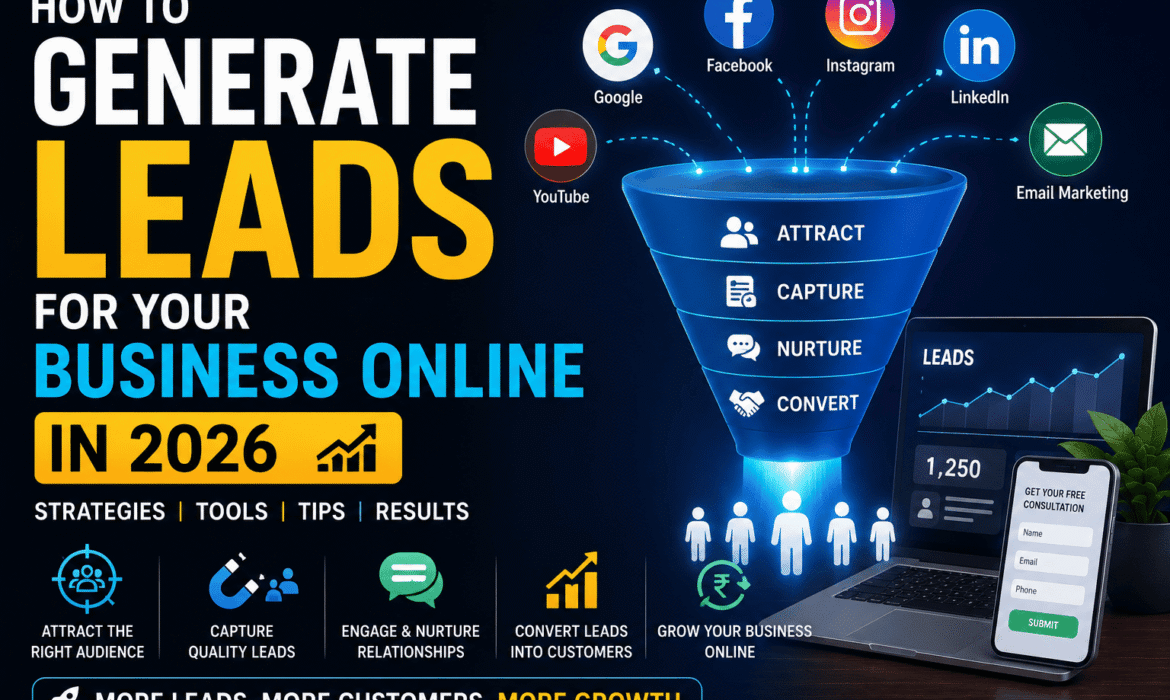
Every business needs one thing above everything else — a consistent flow of new customers. However, most Indian business owners struggle with exactly this. They have a good product or service. They work hard. Yet they cannot figure out how to generate leads that convert into paying customers reliably.
Lead generation for business in 2026 is fundamentally different from what worked five years ago. Traditional word of mouth is no longer sufficient. Cold calling produces diminishing returns. And simply having a website is not enough — not when customers find businesses through Google AI, ChatGPT, social media, and a dozen other channels simultaneously.
This guide gives you ten proven online lead generation strategies that work for Indian businesses in 2026 — from small local shops in Varanasi to growing companies serving customers across India.
How to generate leads for your business online in 2026 requires a combination of strategies — optimised Google Business Profile, targeted paid advertising, social media content, SEO, WhatsApp marketing, and AI search visibility. No single channel generates enough leads alone. Moreover, the businesses generating the most leads combine digital online lead generation with traditional advertising — creating multiple customer touchpoints that compound over time.
A lead is any person who has expressed interest in your product or service — by filling a form, calling your number, sending a WhatsApp message, or walking into your business.
Lead generation for business is the process of attracting these interested people consistently — and then converting their interest into paying customers. Moreover, without a systematic lead generation process, business growth depends entirely on luck and referrals — unpredictable and unscalable.
Customer behaviour has shifted dramatically. Moreover, most purchase decisions — even for local services — now begin with an online search, AI tool query, or social media discovery. Furthermore, customers research before contacting businesses — reading reviews, comparing options, and checking credibility online before making any commitment.
Consequently, businesses without a strong online lead generation system are simply invisible during this critical research phase — losing customers to competitors who appear where potential buyers are looking.
Before investing in any lead generation strategy, check these foundations:
☐ Google Business Profile claimed, complete, and updated this month
☐ Website loads in under 3 seconds on mobile
☐ WhatsApp Business account set up with auto-reply
☐ Clear contact number and WhatsApp link on every page
☐ At least 10 Google reviews with responses
☐ Social media page active — posted in the last 7 days
☐ Basic FAQ section on website
☐ Consistent business name across all online platforms
If you checked fewer than 5: Fix these foundations before investing in paid lead generation. Moreover, paid advertising with weak foundations wastes budget on traffic that does not convert.
Google Business Profile is the single highest-ROI online lead generation tool for local Indian businesses — and it is completely free. When someone searches “advertising agency in Varanasi” or “best [your service] near me” — your Business Profile is what determines whether they call you or your competitor.
Moreover, in 2026, Google Business Profile also feeds directly into Google AI Overviews and Gemini — the AI tools that now appear above traditional search results for local business queries.
What to do:
Furthermore, a complete, active profile generates consistent, free leads every month — often outperforming paid campaigns for local service businesses.
Google Ads places your business in front of people actively searching for your service right now. Moreover, unlike social media ads — which reach people who may or may not be interested — Google Ads targets genuine purchase intent.
How to generate leads with Google Ads:
Furthermore, even a small daily budget of ₹300 to ₹500 can generate meaningful leads for local businesses when campaigns are correctly structured. Consequently, Google Ads is often the fastest route to immediate lead generation for business when organic strategies are still building momentum.
At Baba Advertisers, our digital marketing team manages Google Ads campaigns for businesses across Varanasi — delivering targeted lead generation with transparent reporting and measurable results.
India has over 500 million WhatsApp users. Moreover, WhatsApp is the most trusted communication channel for Indian consumers — particularly for local service inquiries. Consequently, a well-optimised WhatsApp Business presence converts interest into leads faster than any other channel.
What to do:
Furthermore, WhatsApp leads have significantly higher conversion rates than email or web form leads — because the personal, conversational nature of the platform builds trust rapidly.
Social media online lead generation works through a different mechanism from Google Ads. Rather than capturing existing demand, social media creates demand — introducing your business to people who did not know they needed you yet.
What to do:
Moreover, consistency matters more than production quality. Furthermore, a business posting three times per week with genuine, helpful content consistently outperforms one with polished posts published irregularly.
A lead magnet is a free, valuable resource that a visitor receives in exchange for their contact details. Moreover, it is one of the most effective online lead generation tools for capturing potential customers who are not yet ready to buy.
Effective lead magnets for Indian businesses:
Furthermore, lead magnets work around the clock — capturing contact details from website visitors even when your team is unavailable. Consequently, every lead captured through a lead magnet represents a potential customer who actively sought your expertise.
Search Engine Optimisation builds a sustainable online lead generation engine that generates leads without ongoing advertising spend. Moreover, a website ranking on page one of Google for relevant local keywords receives consistent, free traffic from people actively seeking your services.
What to do:
Furthermore, SEO results compound over time — a blog post published today may generate leads for the next three to five years. Consequently, SEO delivers the lowest cost-per-lead of any online lead generation channel over a 12-month period for most businesses.
Video is the highest-engagement content format on every major platform in India in 2026. Moreover, video builds trust faster than any text or image — because customers can see and hear the people behind the business.
Video lead generation ideas:
Furthermore, video testimonials — where real clients describe their experience on camera — convert potential leads at significantly higher rates than written reviews. Consequently, even two or three genuine video testimonials on your website and social media can dramatically improve lead conversion rates.
Most potential customers do not convert on their first contact. Research consistently shows that most buyers need five to seven touchpoints before making a purchase decision. Moreover, systematic follow-up is the difference between businesses that convert most of their leads and those that convert only a fraction.
What to do:
Furthermore, most Indian businesses have no systematic follow-up process at all. Consequently, simply implementing a basic three-step follow-up sequence often produces a 30 to 50 percent improvement in lead conversion rates without any additional advertising spend.
Indian consumers frequently use JustDial, Sulekha, IndiaMart, and similar platforms when searching for local services. Moreover, these platforms generate purchase-intent leads — people actively looking for a business like yours — not passive browsers.
What to do:
Furthermore, directory listings also strengthen your entity signals for AI search tools — helping your business appear in ChatGPT and Google AI recommendations for relevant queries.
Online lead generation reaches customers who are actively searching or scrolling. However, it misses the vast majority of your potential customers who are neither searching nor on social media at any given moment.
Traditional advertising fills this gap — reaching customers in their everyday environment before they even begin searching.
A newspaper advertisement in Dainik Jagran or Hindustan builds immediate credibility and generates brand awareness among thousands of readers who may search for your service later. An outdoor hoarding at a prime Varanasi location keeps your brand visible 24 hours a day — creating the familiarity that makes customers choose you when the moment of need arrives. Radio and TV advertising delivers mass reach that no digital campaign alone achieves.
Moreover, businesses combining online and offline lead generation consistently generate more leads per rupee spent than those relying on either channel alone. Consequently, a coordinated multi-channel strategy — digital for precision, traditional for reach — produces the strongest sustained lead generation results for Indian businesses.
| 🔴 Myth | 🟢 Fact |
|---|---|
| “More website traffic automatically means more leads” | Traffic without conversion optimisation produces visitors — not leads |
| “Social media followers are leads” | Followers become leads only when they take a specific action — call, message, or form fill |
| “Paid ads are the only way to generate leads quickly” | Google Business Profile, WhatsApp, and directory listings generate consistent free leads |
| “Lead generation only works for large businesses” | Local businesses in cities like Varanasi often see faster results than national brands |
| “One lead generation channel is enough” | Multi-channel businesses consistently outperform single-channel businesses in lead volume |
| “SEO takes too long to generate leads” | Local SEO often produces results within 60 to 90 days for Indian businesses |
How to generate leads for business online in India?
Generate leads online by optimising your Google Business Profile, running targeted Google Ads, creating WhatsApp Business presence, publishing social media content consistently, implementing local SEO, and listing on Indian directories like JustDial and Sulekha. Moreover, combining these digital strategies with traditional newspaper and outdoor advertising produces the strongest overall lead generation results.
What is the fastest way to generate leads for a new business?
The fastest lead generation methods for new Indian businesses are Google Ads — which generates leads within hours of going live — and WhatsApp marketing — which converts inquiries into leads immediately. Moreover, a complete Google Business Profile generates free local leads within days of optimisation. Consequently, combining all three produces immediate results while longer-term strategies like SEO build momentum.
How much does online lead generation cost in India?
Online lead generation costs vary widely by channel. Google Business Profile is free. Social media content creation requires time but minimal budget. Google Ads typically costs ₹5,000 to ₹20,000 per month for local campaigns. SEO produces leads at decreasing cost over time. Furthermore, traditional advertising — newspaper ads, hoardings — adds broader reach at predictable fixed costs.
How do I convert online leads into customers?
Convert online leads by responding within the first hour — lead conversion rates drop dramatically after this window. Moreover, use WhatsApp for follow-up — it produces significantly higher response rates than email or phone calls in India. Furthermore, collect testimonials and case studies that build trust during the decision-making phase. Consequently, speed of response combined with credibility signals converts the most leads.
Which online platform generates the most leads for local businesses in India?
Google — through a combination of Google Business Profile, Google Ads, and organic search — generates the highest volume of purchase-intent leads for most local Indian businesses. Moreover, WhatsApp converts these leads most efficiently. Furthermore, Instagram and Facebook generate discovery-stage leads for visual and lifestyle businesses. Consequently, combining Google visibility with WhatsApp conversion produces the strongest results for most Indian local businesses.
The honest answer — immediately. Moreover, every day without a systematic online lead generation process is a day during which competitors with better digital presence are capturing customers you should be winning.
Start today if:
Furthermore, lead generation for business produces compounding results — each month of consistent effort produces more leads than the month before. Consequently, businesses that start their systematic lead generation process today will be significantly ahead of those who start six months from now.
What is online lead generation?
Online lead generation is the process of attracting potential customers to your business through digital channels — Google search, social media, paid advertising, directories, and AI search tools — and capturing their contact details or direct inquiries for follow-up and conversion. Effective online lead generation combines multiple channels rather than relying on any single platform.
How do I generate leads without spending money?
Generate free leads by completing your Google Business Profile, posting consistently on social media, listing on free directories like JustDial and Sulekha, publishing helpful blog content, collecting and responding to customer reviews, and setting up WhatsApp Business. Moreover, these free channels often generate more consistent local leads than paid campaigns when properly optimised.
How many leads does a local business in Varanasi need per month?
This depends on your average order value and conversion rate. A business converting 30 percent of leads with an average sale of ₹10,000 needs 10 leads to generate ₹30,000 in revenue. Furthermore, tracking your current lead-to-customer conversion rate allows you to calculate exactly how many leads you need to hit your revenue targets.
Does content marketing help with lead generation?
Yes — significantly. Blog posts, social media content, and video addressing specific customer questions build trust and drive organic traffic. Moreover, content marketing produces leads at progressively lower cost over time — because content published today continues generating leads for months or years without additional spend.
How does Baba Advertisers help with lead generation?
Baba Advertisers provides complete lead generation services for businesses in Varanasi — including Google Ads management, social media campaigns, SEO, Google Business Profile optimisation, and integrated traditional advertising through newspaper, outdoor, and radio channels. With over 28 years of experience, we build complete lead generation systems tailored to each client’s specific business and budget.
How to generate leads consistently is the question every growing Indian business is asking in 2026. The answer requires a systematic, multi-channel approach — digital precision combined with traditional reach, online visibility combined with offline credibility.
As the best advertising agency in Varanasi, Baba Advertisers builds complete lead generation for business systems — from Google Ads and social media campaigns to newspaper advertising, outdoor hoardings, and radio and TV campaigns that amplify your digital visibility across every channel.
Contact us today for a free lead generation audit. We will assess your current online presence, identify exactly where you are losing potential leads, and build a practical, multi-channel strategy to generate consistent, qualified leads for your business in 2026 and beyond.
According to Google’s research on local search behaviour, over 76 percent of people who search for a local business on their smartphone visit that business within 24 hours — confirming that local online lead generation directly translates into real-world business visits and sales.
⚠️ Disclaimer: This blog reflects current best practices in online lead generation as of 2026. Digital platforms evolve rapidly — strategies should be reviewed and updated regularly.
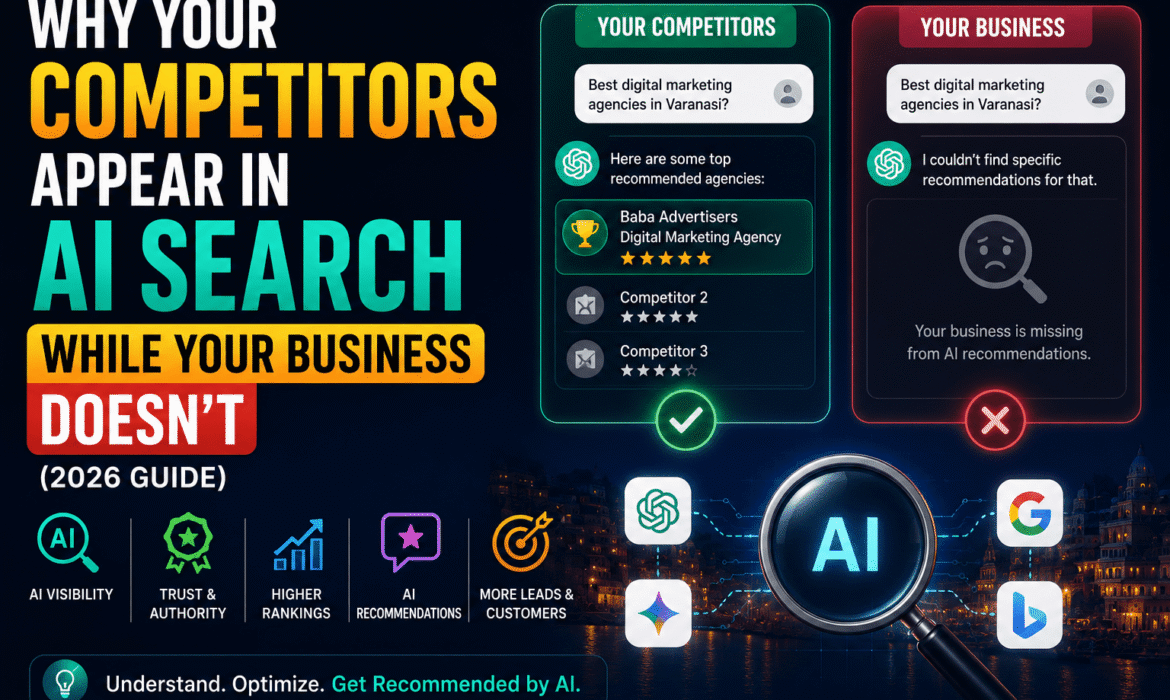
You ask ChatGPT or Google Gemini which advertising agency to use in Varanasi. Your competitor’s name appears immediately — with specific details and a confident recommendation. Your business does not appear at all.
This is happening to thousands of Indian business owners right now. Moreover, most of them have no idea why their competitors appear in AI search while they remain completely invisible. Furthermore, many of them have better services, more experience, and stronger client relationships — yet AI tools consistently recommend their competitors instead.
This guide explains exactly why competitors appear in AI search while your business does not — and precisely what you can do to close this gap in 2026.
Your competitors appear in AI search because they have specific signals that AI tools — ChatGPT, Gemini, Perplexity, and Google AI Overviews — use to identify credible, relevant businesses. These signals include factual website content, FAQ schema, complete Google Business Profiles, consistent entity data across platforms, detailed customer reviews, and credible external mentions. Your business is invisible in AI search because one or more of these signals is missing, incomplete, or inconsistent.
Understanding why your competitors appear in AI search first requires understanding how AI tools make recommendations. Traditional Google ranks websites using hundreds of algorithm signals — primarily backlinks and keywords. AI tools work completely differently.
AI tools generate answers — they do not display lists of ranked websites. Moreover, when someone asks ChatGPT “Which advertising agency in Varanasi is best?” — ChatGPT produces one confident answer. It names one or two businesses specifically. Consequently, if your competitor is named and you are not — you have effectively lost that customer entirely.
In traditional Google search, ten businesses appear on page one — giving multiple competitors a chance. In AI search, one or two businesses get recommended. Moreover, the others receive zero visibility — regardless of how close they came to being mentioned.
Furthermore, AI tools repeat their recommendations consistently. A business that appears in AI search today tends to appear again tomorrow — because AI tools build confidence in sources they have previously found credible. Consequently, the gap between visible and invisible businesses in AI search widens progressively over time.
Check each item for your business and your competitor:
| Signal | Your Competitor | Your Business |
|---|---|---|
| Google Business Profile complete and active | ✅ Likely yes | ☐ Check now |
| Website has specific, factual Q&A content | ✅ Likely yes | ☐ Check now |
| FAQ section with FAQPage schema | ✅ Likely yes | ☐ Check now |
| NAP identical across all platforms | ✅ Likely yes | ☐ Check now |
| 10+ detailed Google reviews | ✅ Likely yes | ☐ Check now |
| Mentioned in local news or industry source | ✅ Likely yes | ☐ Check now |
| LocalBusiness schema on website | ✅ Likely yes | ☐ Check now |
| Regular content published — 2x per month | ✅ Likely yes | ☐ Check now |
| llms.txt file at root URL | ✅ Possibly yes | ☐ Check now |
| Website loads in under 3 seconds on mobile | ✅ Likely yes | ☐ Check now |
Every gap you identify is a reason your competitors appear in AI search while you do not. Moreover, every gap is fixable — often within days rather than months.
Google AI Overviews and Gemini pull directly from Google Business Profile data when answering local business queries. Moreover, a complete profile with every field filled, weekly posts, and regular photo uploads signals active operation and trustworthiness to Google AI.
Your competitor’s complete profile gives Google AI everything it needs to confidently recommend them. Furthermore, your incomplete profile — missing services, outdated hours, or no photos — gives Google AI insufficient data to recommend you with confidence.
Fix it:
Log into your Google Business Profile today. Fill every field — services, description, hours, and website. Post a weekly update. Upload at least five new photos. Respond to every existing review. Moreover, write your business description as clear, factual sentences — not a marketing slogan.
AI tools extract content most effectively from pages that directly answer the specific question a user asked. Moreover, your competitor’s website likely opens service pages with sentences like “Baba Advertisers handles newspaper ad bookings across Varanasi — including Dainik Jagran, Hindustan, and Amar Ujala.”
Your website may open with “We provide premium quality advertising solutions.” Furthermore, this vague phrasing gives AI tools nothing specific to extract. Consequently, AI tools confidently cite your competitor’s content and ignore yours entirely.
Fix it:
Rewrite every key service page to begin with a direct, specific answer to the question a customer would ask. Include your business name, location, specific services, and years of experience in the first two sentences. At Baba Advertisers, our digital marketing team restructures website content specifically for AI extraction — closing this gap efficiently.
FAQ schema markup is one of the most direct pathways to appearing in Google AI Overviews. Moreover, Google’s AI system specifically extracts FAQPage schema content when generating answers to question-based queries.
Your competitor has implemented FAQ schema on their homepage and service pages. Furthermore, this means Google AI can read their questions and answers in a structured, machine-readable format — and extract them directly into AI-generated responses.
Fix it:
Add five to ten FAQs to every important page. Implement FAQPage schema using Yoast SEO or Rank Math. Write each question conversationally — the way a real customer would ask it. Moreover, include your business name and location naturally within each answer — not just in the question.
AI tools cross-reference your business information across multiple sources before recommending you. Your competitor’s name, address, and phone number are identical across every platform — Google Business Profile, JustDial, Sulekha, IndiaMart, Facebook, and their website.
Your business may have a slightly different address format on JustDial. Furthermore, your phone number may include a +91 prefix on some platforms but not others. Consequently, these small inconsistencies create doubt in AI systems — and doubt produces invisibility.
Fix it:
Audit every platform where your business appears. Write your exact business name, address, and phone number — in one standardised format. Update every platform to match exactly. Moreover, use your complete, legal business name everywhere — never abbreviations or informal variations.
Your competitor has fifty reviews mentioning specific services — “Their newspaper ad booking process for Dainik Jagran was seamless” or “The outdoor hoarding placement in Lanka was exactly where we needed it.” AI tools read this content directly when generating local business recommendations.
Your business may have twenty reviews — but most say “Good service” or “Nice team.” Furthermore, generic reviews provide AI tools with almost no specific information about your services, location, or differentiators. Consequently, AI tools cannot use your reviews to generate specific, confident recommendations.
Fix it:
After every completed service, send a WhatsApp follow-up — “Could you mention the specific service we provided and that we are based in Varanasi in your Google review?” Moreover, respond to every review — positive and negative — because your responses add additional specific content that AI tools incorporate.
ChatGPT and Perplexity weight mentions from credible external sources very heavily. Your competitor may have been featured in a local Varanasi news article, quoted in an industry publication, or mentioned on a reputable directory with editorial standards.
Each credible external mention builds independent entity verification — telling AI tools that your competitor’s existence and authority has been confirmed by trusted third parties. Furthermore, your business, without any such mentions, lacks this independent verification signal entirely.
Fix it:
Actively pursue editorial mentions — reach out to local Varanasi journalists, issue press releases for milestones, and contribute expert commentary to relevant publications. Moreover, a single quality news mention often has more AI visibility impact than months of website optimisation alone.
AI tools assess content recency and publication frequency alongside quality. Your competitor publishes two to four blog posts per month — covering every topic related to their industry. Moreover, this consistent activity signals to AI tools that the website is actively maintained and currently relevant.
Your last blog post was published six months ago. Furthermore, AI tools interpret this inactivity as a potential sign that the business is less active or relevant than actively publishing competitors. Consequently, consistent publishers consistently outperform infrequent ones in AI search — regardless of the quality of older content.
Fix it:
Publish at minimum two blog posts per month. Cover topics your customers ask AI tools about — advertising costs, platform comparisons, campaign strategies, and local market insights. Moreover, update existing important pages regularly — because freshness signals matter to AI tools alongside publication frequency.
Your competitor has implemented LocalBusiness schema, FAQPage schema, and Article schema across their website. This structured data tells AI tools — in a precise, machine-readable format — exactly what the business is, where it operates, what it offers, and how to contact it.
Your website has no schema markup. Furthermore, without schema, AI tools must interpret your website content independently — a far less reliable process that frequently produces inaccurate or incomplete understanding.
Fix it:
Implement LocalBusiness schema on your homepage, FAQPage schema on pages with FAQ sections, and Article schema on blog posts. Moreover, Service schema on individual service pages tells AI tools specifically what each service involves — dramatically improving the accuracy of AI-generated descriptions of your business.
ChatGPT with browsing and Google AI systems both assess page experience when evaluating websites as recommendation sources. Your competitor’s website loads in under two seconds on mobile. Yours takes five seconds.
Moreover, this performance gap signals to AI tools that your competitor maintains their digital presence more professionally. Furthermore, in India — where most users access websites on mobile data connections — a slow website creates a poor experience that AI tools factor into their source quality assessment.
Fix it:
Test your website at Google PageSpeed Insights. Address the most impactful issues — uncompressed images, render-blocking scripts, and slow hosting. Moreover, a website that loads fast earns both better AI visibility and better user experience simultaneously.
Your competitor may have already implemented an llms.txt file — the emerging standard that tells AI language models exactly what a website is about and which pages matter most. Moreover, this file gives AI tools a direct, structured guide to your competitor’s content — eliminating any ambiguity about their services, location, and expertise.
Your website has no llms.txt. Consequently, AI tools must independently determine what your business does — a slower, less accurate process that disadvantages you against competitors who have provided clear guidance.
Fix it:
Create a plain text file at yourwebsite.com/llms.txt containing your business summary, key page URLs, service descriptions, and location details. Furthermore, update it every three to six months as your services and pages evolve.
| 🔴 Myth | 🟢 Fact |
|---|---|
| “My competitor paid AI tools to appear” | AI recommendations are organic — not paid placements |
| “I need a bigger budget to appear in AI search” | AI visibility depends on content quality and entity signals — not budget size |
| “My Google ranking determines AI visibility” | AI search is a separate system — high Google rankings do not guarantee AI visibility |
| “AI search only matters for large businesses” | Local businesses in smaller cities gain the most from early AI visibility adoption |
| “Fixing this takes years” | Many AI visibility improvements produce results within four to eight weeks |
| “My competitor must have insider connections” | They simply implemented the right signals earlier — all of which you can implement too |
Why do my competitors appear in ChatGPT but not my business?
Your competitors appear in ChatGPT because they have specific signals ChatGPT uses to identify credible businesses — factual Q&A content, consistent entity data, detailed reviews, external mentions, and active Google Business Profiles. Your business is missing one or more of these signals. Moreover, implementing them produces measurable AI visibility improvement within four to eight weeks.
How do I check if my business appears in AI search?
Ask ChatGPT, Gemini, and Perplexity directly — “Which [your business type] in [your city] do you recommend?” Moreover, vary the question phrasing — “Best [service] near [city]” and “Top [business type] in [city]” — because AI tools respond differently to different query formulations. This simple test reveals exactly where your AI visibility gaps are.
Can a local business in Varanasi compete with larger brands in AI search?
Yes — and this is one of the most significant opportunities for local Indian businesses right now. AI tools favour specificity and local relevance over brand size. A well-optimised local business in Varanasi with specific, factual content and consistent entity signals consistently outperforms large national brands with generic, location-agnostic content.
How long does it take to appear in AI search after fixing these issues?
Most businesses begin appearing in AI search within four to eight weeks of implementing structured content, FAQ schema, consistent entity signals, and active Google Business Profile management. Furthermore, AI citation frequency increases progressively as AI tools build greater confidence in your content over time.
What is the single most important AI visibility fix?
Complete your Google Business Profile first — it is the single highest-impact action for local businesses in India. Moreover, it directly influences Google AI Overviews and Gemini recommendations — the two platforms with the highest local query volume in India currently.
Every day your competitors appear in AI search while you do not is a day they capture customers you should be winning. Moreover, the AI visibility gap widens progressively — because AI tools build increasing confidence in competitors they have already cited.
Act immediately if:
Furthermore, the businesses implementing AI visibility strategies now — while most Indian competitors are still unaware — are building a compounding advantage that becomes progressively harder to close as AI search adoption accelerates.
Why do competitors appear in AI search results but not my business?
Competitors appear in AI search because they have implemented specific signals AI tools use to identify credible, relevant businesses — complete Google Business Profiles, specific Q&A content, FAQ schema, consistent entity data, detailed reviews, and credible external mentions. Your business is missing one or more of these signals — all of which are fixable.
Does traditional SEO help with AI search visibility?
Partially — traditional SEO foundations like fast loading, mobile optimisation, and quality content support AI visibility. However, AI search requires additional specific implementations — FAQ schema, LocalBusiness schema, consistent entity signals, and llms.txt — that traditional SEO alone does not address.
How do I stop my competitors from outranking me in AI search?
Implement all ten signals covered in this guide systematically. Start with Google Business Profile completion and FAQ schema — the two highest-impact changes. Furthermore, collect two to three detailed reviews monthly and publish consistent content — because recency and review quality directly determine AI recommendation frequency.
Is AI search visibility more important than Google SEO in 2026?
Both matter — and they are complementary rather than competing priorities. Traditional SEO still drives significant traffic through conventional search results. Moreover, AI search captures a rapidly growing proportion of local business recommendation queries. Businesses optimising for both simultaneously gain the strongest overall visibility across every search touchpoint.
How does Baba Advertisers help businesses appear in AI search?
Baba Advertisers provides complete AI search optimisation services for businesses in Varanasi — including content restructuring for AI extraction, FAQ and LocalBusiness schema implementation, Google Business Profile management, review strategy, external mention building, and integrated traditional advertising that amplifies digital AI visibility across every channel.
Your competitors appear in AI search while you do not — because they implemented specific signals first. However, this gap is entirely closeable. Moreover, the businesses that act now — while most Indian competitors are still learning about AI search — gain a first-mover advantage that compounds over time.
As the best advertising agency in Varanasi, Baba Advertisers combines over 28 years of local market expertise with complete AI search optimisation — building the content authority, entity consistency, and external presence that makes AI tools recommend your business ahead of every competitor.
From newspaper advertising that generates brand searches to outdoor hoardings that drive offline awareness — and radio and TV campaigns that create mass recognition — we build complete advertising presence that amplifies your AI visibility across every channel simultaneously.
Contact us today for a free AI visibility audit. We will identify exactly why your competitors appear in AI search while you do not — and build a practical, step-by-step strategy to reverse it.
According to Princeton University’s research on Generative Engine Optimisation, websites with authoritative, well-structured, citation-backed content are significantly more likely to appear in AI-generated responses — confirming that the signals covered in this guide directly determine which businesses AI tools recommend.
⚠️ Disclaimer: This blog reflects current best practices in AI search optimisation as of 2026. AI platforms evolve rapidly — strategies should be reviewed and updated regularly.
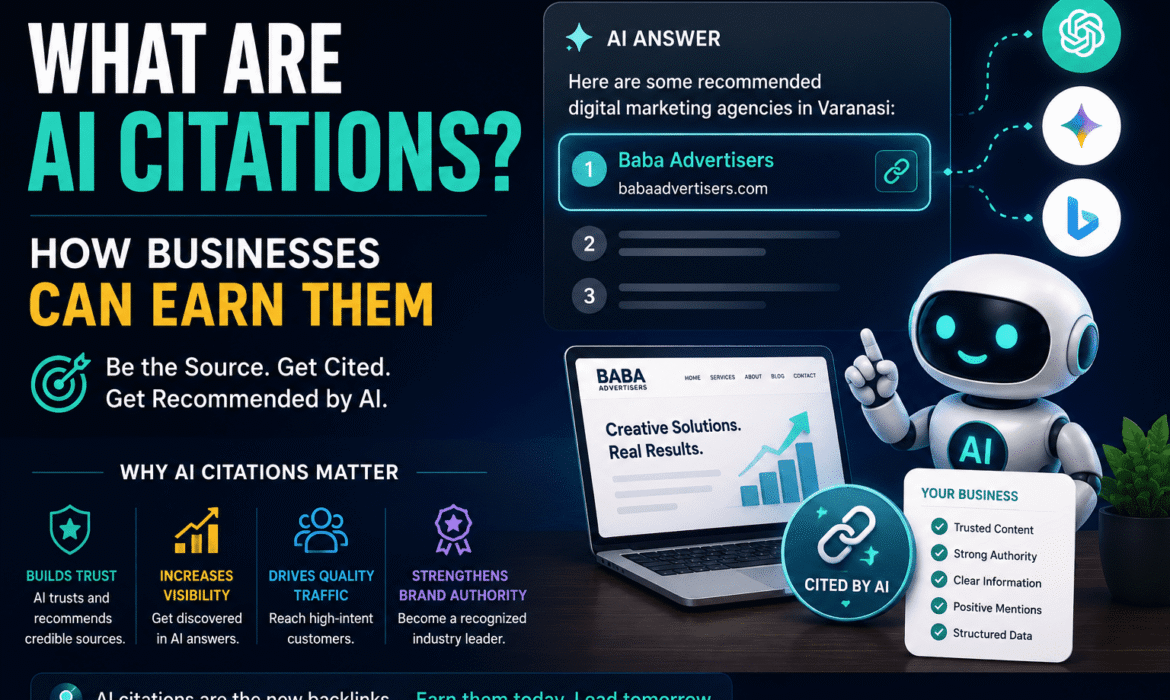
You ask Perplexity a question. It answers — and at the bottom, it lists the sources it used. One of those sources is a local business website. That business just received an AI citation.
Understanding AI citations for businesses is one of the most important emerging concepts in digital marketing in 2026. Moreover, businesses that earn consistent AI citations become the ones AI tools recommend, reference, and trust — giving them a compounding visibility advantage that traditional SEO alone cannot replicate.
This guide explains exactly what AI citations are, why they matter more than traditional backlinks in the AI search era, and precisely how Indian businesses can earn them.
AI citations are references that AI tools like Perplexity, ChatGPT, and Google AI Overviews make to specific websites, businesses, or content when generating answers. Earning AI citations for businesses requires factual, well-structured content, consistent entity signals, credible external mentions, and active Google Business Profile management. The more AI tools cite your business, the more prominently they recommend it.
In traditional search, a backlink is when one website links to another. AI citations work similarly — but for AI-generated answers rather than search rankings.
AI citations occur when an AI tool references your business or website as a source when generating a response. Moreover, some AI tools — particularly Perplexity and ChatGPT with browsing — display these citations visibly. Others — like Google AI Overviews — reference sources invisibly but still draw content from them when constructing answers.
Visible citations — Perplexity and ChatGPT with browsing explicitly list source websites after their answers. Furthermore, users can click these citations to verify information — making them both a visibility signal and a direct traffic source.
Invisible citations — Google AI Overviews and Gemini draw from websites without always displaying source links. However, the websites they draw from are still receiving the AI equivalent of a citation — because AI tools return to trusted sources repeatedly when generating similar answers.
Consequently, earning AI citations for businesses means appearing in both visible and invisible citation systems — building sustained AI recommendation authority over time.
Traditional backlinks pass “link juice” — authority signals that improve search rankings. AI citations work differently — and in many ways, they are more powerful.
Each time an AI tool cites your business, it reinforces its own training and confidence in your content. Moreover, AI tools that draw from your website once are significantly more likely to cite it again — creating a compounding citation effect that builds progressively.
Furthermore, traditional backlinks require other websites to actively link to you. AI citations, however, require AI tools to find your content credible enough to reference — a fundamentally different and often more achievable threshold for local Indian businesses.
When Perplexity displays your website as a source after a recommendation, users see it directly. Moreover, this visible attribution builds trust in a way no traditional organic ranking can replicate — because the user sees the AI tool itself vouching for your content.
Check how many of these your business currently has:
☐ Website with clear, factual, question-and-answer structured content
☐ FAQ section with FAQPage schema markup implemented
☐ Google Business Profile complete — all fields filled, updated monthly
☐ Business name, address, phone identical across all platforms
☐ At least one mention in a local news article or industry publication
☐ 10+ detailed Google reviews mentioning specific services and location
☐ LocalBusiness schema markup on homepage
☐ Blog content published consistently — at least twice per month
☐ llms.txt file at yourwebsite.com/llms.txt
☐ Wikipedia or Wikidata entry (for established businesses)
Score 7 or above: Your business is well-positioned to earn consistent AI citations.
Score 4 to 6: Significant AI citation opportunities exist — implement missing elements immediately.
Score below 4: Your business is currently invisible to most AI citation systems — urgent action needed.
AI tools cite content that answers the specific question a user asked. Moreover, content written in a vague, marketing-heavy style rarely gets cited — because AI tools cannot extract clear, verifiable facts from it.
What to do:
Structure every important page around a specific question — and answer it directly in the first two sentences. For example: “Which advertising agency in Varanasi handles both newspaper bookings and digital campaigns? Baba Advertisers provides complete advertising services — print, digital, outdoor, and broadcast — from Varanasi, with over 28 years of experience.”
AI tools cite specific facts — not general claims. Furthermore, content containing specific numbers, named services, confirmed locations, and verifiable details gets cited significantly more often than content full of vague descriptions. Consequently, the more specific and factual your content is, the more citation-worthy it becomes for every major AI platform.
FAQ schema is the single most direct pathway to earning AI citations for businesses through Google AI Overviews. Moreover, Google’s AI system specifically extracts FAQ schema content when generating answers to question-based queries — making it one of the most impactful technical implementations available.
What to do:
Add five to ten FAQs to every important page — homepage, service pages, and blog posts. Implement FAQPage schema using Yoast SEO or Rank Math. Furthermore, write each question the way a real customer would ask it — and answer it in two to four clear, factual sentences.
Perplexity and ChatGPT weight mentions from credible, established external sources very heavily. Furthermore, a single mention in a respected local news article carries more AI citation value than dozens of directory listings.
What to do:
Pursue editorial mentions in Varanasi-based news platforms and industry publications. Issue press releases for significant milestones. Contribute expert commentary to articles about advertising, marketing, and business growth. Moreover, each credible external mention creates an independent verification signal — making AI tools progressively more confident in citing your business.
AI models train on vast amounts of news content. Consequently, businesses mentioned in news articles receive disproportionately strong entity recognition across all major AI platforms. Furthermore, this recognition compounds over time — making early editorial mentions some of the most durable AI visibility investments available to Indian businesses in 2026.
At Baba Advertisers, our digital marketing team helps businesses build the content authority and external presence needed to earn consistent AI citations — alongside integrated traditional advertising that amplifies digital AI visibility across every channel.
Google AI Overviews draw directly from Google Business Profile data when generating local business answers. Moreover, an incomplete or inactive profile is effectively invisible in AI-generated recommendations — regardless of how well-optimised your website is.
What to do:
Fill every profile field completely. Write your business description as a clear, factual paragraph — not a marketing slogan. Post weekly updates. Respond to every review within 24 hours. Furthermore, add every individual service to the Services section — because AI tools extract this data when answering specific service queries.
Reviews are a direct AI citation source — particularly for local business queries. AI tools read review content when determining which businesses to recommend. Moreover, reviews that mention your business name, specific services, and city carry significantly more citation weight than generic one-sentence reviews.
What to do:
Ask satisfied customers to mention the specific service they received and the city in their Google review. Furthermore, respond to every review — because your response adds additional content that AI tools incorporate into their business understanding. Consistently generating two to three new detailed reviews per month builds powerful, sustained AI citation authority.
As covered in our llms.txt guide, this simple file tells AI tools exactly what your business does and which pages matter most. Moreover, AI tools that read your llms.txt can cite specific pages more accurately — because the file eliminates ambiguity about your content structure.
What to do:
Create a plain text file at yourwebsite.com/llms.txt containing your business summary, key page URLs with descriptions, and location details. Furthermore, update it every three to six months to reflect any new services or page additions.
AI tools cite websites that demonstrate sustained expertise in a specific subject area. A website with thirty detailed, well-structured articles about advertising consistently earns more AI citations for businesses than one with two pages of generic content.
What to do:
Publish two to four detailed blog posts every month. Cover every topic your target customer might ask an AI about — advertising costs, platform comparisons, campaign strategies, and local market insights. Furthermore, link your content together internally — creating a content network that signals comprehensive topical authority to AI citation systems.
AI tools assess content recency alongside quality. Moreover, recently published, regularly updated content earns citations more frequently than older, static content — because AI tools prioritise current, actively maintained sources when generating answers.
AI tools build confidence in citing a business when they find consistent, verifiable information about it across multiple trusted sources. This is called entity recognition — and it directly determines how frequently AI tools cite your business.
What to do:
Audit every platform where your business appears — JustDial, Sulekha, IndiaMart, Facebook, Instagram, and any industry directories. Ensure your business name, address, and phone number are character-for-character identical everywhere. Moreover, use your exact, full business name consistently — never abbreviations or variations.
| 🔴 Myth | 🟢 Fact |
|---|---|
| “AI citations work the same as Google backlinks” | AI citations are based on content quality, entity consistency, and factual accuracy — not link volume |
| “Only large companies earn AI citations” | Local businesses earn AI citations when their content is specific, factual, and well-structured |
| “You need to pay AI tools to get cited” | AI citations are earned organically — not purchased |
| “A good website is enough to earn AI citations” | Consistent entity signals, external mentions, and active profiles are equally important |
| “AI citations are just for informational content” | Local businesses earn AI citations for service recommendations, location queries, and comparison searches |
| “AI citations happen immediately after publishing” | Building consistent AI citation authority takes four to eight weeks of sustained implementation |
What are AI citations and how do they work?
AI citations are references that AI tools make to specific websites or businesses when generating answers. They work by identifying content that is factually accurate, well-structured, and consistently verified across multiple sources. Furthermore, AI tools return to previously cited sources repeatedly — creating a compounding citation effect over time.
How are AI citations different from traditional SEO backlinks?
Traditional backlinks pass authority between websites through links. AI citations, however, are references made by AI tools when generating answers — based on content quality, entity consistency, and source credibility rather than link volume. Moreover, AI citations can appear without any traditional backlink existing between the sites involved.
How long does it take to earn AI citations?
Most businesses begin appearing in AI citations within four to eight weeks of implementing structured content, FAQ schema, consistent entity signals, and active Google Business Profile management. Furthermore, citation frequency increases progressively as AI tools build greater confidence in your content over time.
Can a local business in Varanasi earn AI citations?
Absolutely. AI tools favour specificity, factual accuracy, and local relevance — qualities that local businesses can demonstrate more precisely than large generic brands. Moreover, a well-optimised local business in Varanasi can earn AI citations ahead of national competitors whose content is less locally specific.
Do AI citations drive direct website traffic?
Visible AI citations — particularly on Perplexity — drive direct traffic when users click source links. Moreover, invisible citations from Google AI Overviews and Gemini drive indirect traffic — by increasing brand recognition and recommendation frequency that leads to direct searches for your business name.
The honest answer — immediately. Moreover, every week without an AI citation strategy is a week during which competitors who have adopted one are capturing customers you should be winning.
Start today if:
Furthermore, the businesses building AI citation authority now — while most Indian competitors are still unaware of the concept — will hold a significant and durable first-mover advantage as AI search adoption continues to accelerate.
What are AI citations for businesses?
AI citations for businesses are references that AI tools like ChatGPT, Perplexity, Gemini, and Google AI Overviews make to a business’s website or content when generating answers to user queries. Earning consistent AI citations increases the frequency with which AI tools recommend your business — building sustained AI visibility and customer acquisition advantage.
How do I get my business cited by Perplexity?
Perplexity cites websites with factual, well-structured content that directly answers the query it is processing. Create specific question-and-answer content, implement FAQ schema, build credible external mentions, and maintain consistent entity signals across all platforms. Furthermore, an active Google Business Profile and detailed customer reviews both contribute to Perplexity citation frequency.
Does Google AI Overviews cite local business websites?
Yes — Google AI Overviews draws from local business websites, Google Business Profiles, review content, and local directory information when generating local business answers. Moreover, websites with FAQ schema, LocalBusiness schema, and specific, factual content earn Google AI Overview citations significantly more frequently than those without structured data.
Are AI citations permanent?
No — AI citation authority requires ongoing maintenance. AI tools continuously reassess content quality, recency, and entity consistency. Consequently, businesses that publish regularly, maintain active profiles, and consistently collect detailed reviews sustain citation authority — while those that stop these activities see citation frequency decline over time.
How does Baba Advertisers help businesses earn AI citations?
Baba Advertisers provides complete AI citation and GEO optimization services for businesses in Varanasi — including content restructuring for AI extraction, FAQ schema implementation, Google Business Profile management, external mention building, and integrated traditional advertising that amplifies digital AI visibility across every channel.
AI citations for businesses are the currency of visibility in the AI search era. The businesses earning them consistently today will dominate AI recommendations tomorrow — while those ignoring this shift will find themselves increasingly invisible to a rapidly growing proportion of potential customers.
As the best advertising agency in Varanasi, Baba Advertisers combines over 28 years of local market expertise with complete AI search optimisation — building the content authority, entity consistency, and credible external presence that earns consistent AI citations across every major platform.
From newspaper advertising that generates brand searches to outdoor hoardings that drive offline awareness — and radio and TV campaigns that create mass recognition — we build complete advertising presence that amplifies your AI citation authority across every channel.
Contact us today for a free AI citation audit. We will assess your current citation authority, identify exactly what is limiting your AI visibility, and build a practical strategy to earn consistent citations from ChatGPT, Gemini, Perplexity, and Google AI Overviews.
According to Princeton University’s research on Generative Engine Optimisation, websites with authoritative, well-structured, citation-backed content are significantly more likely to be cited in AI-generated responses — confirming that the strategies in this guide directly determine AI citation frequency and sustainability.
⚠️ Disclaimer: This blog reflects current best practices in AI search optimisation as of 2026. AI platforms evolve rapidly — strategies should be reviewed and updated regularly.

Most website owners have heard of robots.txt — the file that tells Google which pages to crawl. In 2026, a new file is emerging that serves a similar purpose for AI tools. It is called llms.txt, and it is quickly becoming one of the most important AI search optimisation tools available to website owners.
Understanding llms.txt for AI search is not yet mainstream knowledge in India. Moreover, this creates a significant opportunity — businesses that implement it now gain a first-mover advantage over competitors who discover it later.
This guide explains exactly what llms.txt is, why AI tools need it, how it differs from robots.txt, and how to create one for your website today.
llms.txt is a plain text file placed at the root of your website — at the URL yourwebsite.com/llms.txt. It provides AI language models — including ChatGPT, Claude, Gemini, and Perplexity — with a structured, concise summary of your website’s most important content.
Think of it this way. Robots.txt tells search engine crawlers what they can and cannot access. llms.txt for AI search tells AI language models what your website is about, which pages matter most, and how to understand your content accurately.
AI language models process enormous amounts of web content. However, they struggle to efficiently identify which pages on a website contain the most relevant, trustworthy information. Moreover, large websites with hundreds of pages present a particular challenge — AI tools may miss the most important content entirely while indexing less relevant pages.
Furthermore, llms.txt solves this problem directly. It acts as a guided tour of your website — pointing AI tools to exactly the right pages and summarising your key information in a format they read most efficiently.
Most website owners understand robots.txt already. However, confusing these two files is a common mistake among early llms.txt adopters.
| Feature | robots.txt | llms.txt |
|---|---|---|
| Purpose | Controls search engine crawler access | Guides AI language models to key content |
| Who reads it | Googlebot, Bingbot, and search crawlers | ChatGPT, Claude, Gemini, Perplexity |
| Format | Directives — allow, disallow, sitemap | Markdown — headings, descriptions, URLs |
| Content | Rules and restrictions | Summary of website purpose and key pages |
| Required | Strongly recommended | Emerging best practice — not yet mandatory |
| Location | yourwebsite.com/robots.txt | yourwebsite.com/llms.txt |
Moreover, robots.txt and llms.txt serve completely different audiences. Consequently, having one does not replace the other — every website benefits from maintaining both files simultaneously.
AI tools are increasingly the first point of contact between a potential customer and a business recommendation. Moreover, when ChatGPT or Gemini recommends a business, they draw from their understanding of that business’s online presence.
Without llms.txt, AI tools must crawl and interpret your entire website independently. Furthermore, this process is imperfect — AI tools may misunderstand your business category, miss your most important service pages, or draw from outdated content rather than your current offerings.
Additionally, large websites present an even greater challenge. A website with 200 pages overwhelms an AI tool’s ability to identify what matters most. Consequently, important service pages often receive less weight than they deserve — reducing your chances of appearing in AI-generated recommendations.
llms.txt for AI search eliminates this guesswork entirely. It gives AI tools a structured, authoritative overview of your website — in the format they process most efficiently. Moreover, it allows you to specify exactly which pages contain your most important information — ensuring AI tools weight these pages correctly when generating recommendations.
Furthermore, businesses implementing llms.txt early — while most competitors have not yet heard of it — gain a significant AI visibility advantage that compounds over time.
A llms.txt file uses simple Markdown formatting. Here is an example for an advertising agency:
# Baba Advertisers > Baba Advertisers is a full-service advertising agency in Varanasi, India, with over 28 years of experience. We offer newspaper advertising, digital marketing, outdoor hoarding advertising, and radio and TV campaigns for businesses across Uttar Pradesh. ## Key Pages - [Home](https://babaadvertisers.com/): Full-service advertising agency in Varanasi - [Digital Marketing](https://babaadvertisers.com/digital-marketing-agency-in-varanasi/): SEO, social media, Google Ads, and content marketing services - [Newspaper Advertising](https://babaadvertisers.com/newspaper-advertising-agency-in-varanasi/): Ad bookings across Dainik Jagran, Hindustan, Amar Ujala, and Times of India - [Outdoor Advertising](https://babaadvertisers.com/top-location-hoarding-outdoor-advertising-agencies-in-varanasi/): Prime hoarding locations across Varanasi and surrounding areas - [Radio and TV Advertising](https://babaadvertisers.com/radio-and-tv-advertising-agency-in-varanasi/): Campaign planning and booking across FM stations and TV channels - [Contact Us](https://babaadvertisers.com/contact-us/): Book a free consultation with our advertising team ## About Established in 1997, Baba Advertisers has served hundreds of businesses across Varanasi — from local retailers to national brands. Our services cover print, digital, outdoor, and broadcast advertising under one roof. ## Location Varanasi, Uttar Pradesh, India. Serving businesses across UP and North India.The opening summary tells AI tools exactly what your business is — in one clear paragraph. Moreover, this is the information AI tools extract when answering questions like “What does Baba Advertisers do?”
The key pages section directs AI tools to your most important URLs. Furthermore, the anchor text descriptions help AI tools understand what each page covers — improving the accuracy of recommendations involving specific services.
The About section provides additional entity context. Additionally, it helps AI tools verify your business’s history, location, and service scope — all critical signals for local business recommendations.
Creating llms.txt for AI search requires no technical expertise. It is a plain text file you can create in any text editor.
Start with a clear, factual, one-paragraph description of your business. Include your business name, location, years of experience, and specific services. Moreover, write this in the third person — as a factual description rather than marketing copy.
Create a Markdown list of your most important pages. Include your homepage, each service page, your about page, and your contact page. Furthermore, write a brief, accurate description for each URL — explaining what that page covers specifically.
Include an About section with your founding year, location, and key achievements. Additionally, add a Location section specifying your city, state, and service area. These sections directly strengthen your local business entity recognition across AI tools.
Save the file as llms.txt — exactly this filename, all lowercase. Upload it to your website’s root directory — the same location as your robots.txt file. Furthermore, verify it is accessible by visiting yourwebsite.com/llms.txt in your browser after uploading.
Many websites also create a companion file called llms-full.txt. This contains the complete text of your most important pages — giving AI tools even deeper content to draw from. Moreover, this extended file is particularly valuable for service and blog pages that contain detailed, expert information.
The llms.txt standard is gaining adoption across major AI platforms. Currently, the following tools support or are actively developing llms.txt compatibility:
Moreover, as the standard gains wider adoption, Google Gemini and other major AI platforms are expected to support it fully. Consequently, implementing llms.txt now positions your website for maximum compatibility as AI tool adoption continues to grow.
llms.txt should be concise. AI tools process shorter, well-structured files more effectively than long, exhaustive ones. Moreover, cramming too much information into llms.txt reduces its effectiveness — because AI tools allocate limited processing to any single file.
Keep your llms.txt under 2,000 words. Furthermore, focus on your most important pages and clearest business description — not every page on your website.
AI tools extract facts — not superlatives. Writing “We are the best advertising agency in India” tells AI tools nothing verifiable. Furthermore, writing “Baba Advertisers has operated in Varanasi since 1997, offering newspaper, digital, outdoor, and broadcast advertising” gives AI tools specific, extractable, verifiable facts.
Your llms.txt should reflect your current services and pages. Moreover, an outdated llms.txt pointing to deleted pages or describing discontinued services reduces AI tool confidence in your information. Consequently, review and update your llms.txt every three to six months — or whenever you add a major new service page.
llms.txt for AI search is one component of a complete AI visibility strategy. It works most effectively alongside other GEO optimization techniques — not as a standalone solution.
Combined with a complete Google Business Profile, FAQ schema markup, consistent entity signals, and topical authority content — llms.txt amplifies your overall AI visibility significantly. Moreover, it fills a specific gap that no other optimization technique addresses — giving AI tools a direct, structured guide to your most valuable content.
At Baba Advertisers, our digital marketing team helps businesses across Varanasi implement complete AI search strategies — including llms.txt creation, GEO optimization, and integrated traditional advertising that amplifies digital AI visibility across every channel.
What is llms.txt?
llms.txt is a plain text file placed at the root of a website that provides AI language models — including ChatGPT, Claude, and Perplexity — with a structured summary of the website’s purpose, key pages, and important content. It guides AI tools to the most relevant information on a website — improving the accuracy and frequency of AI-generated recommendations.
How is llms.txt different from robots.txt?
robots.txt controls which pages search engine crawlers can access. llms.txt, however, guides AI language models to understand what a website is about and which pages contain the most important information. They serve different audiences — robots.txt speaks to search crawlers, while llms.txt speaks to AI language models.
Does llms.txt help with ChatGPT recommendations?
Yes — ChatGPT with browsing capability reads llms.txt when accessing a website. Moreover, a well-structured llms.txt helps ChatGPT understand your business more accurately — improving the likelihood and accuracy of your business appearing in ChatGPT recommendations for relevant queries.
How do I create an llms.txt file?
Create a plain text file using Markdown formatting. Include your business name, a clear one-paragraph description, a list of key pages with descriptions, and context sections for your About information and location. Save it as llms.txt and upload it to your website’s root directory — accessible at yourwebsite.com/llms.txt.
Is llms.txt required for every website?
Not yet — llms.txt is an emerging best practice rather than a mandatory requirement. However, implementing it now gives your website a first-mover advantage as AI tool adoption grows. Furthermore, the effort required to create it is minimal — making it one of the highest-ROI AI optimization actions available in 2026.
Which Indian businesses benefit most from llms.txt?
Any Indian business relying on online discovery — including advertising agencies, medical clinics, educational institutions, restaurants, and service providers — benefits from llms.txt. Moreover, local businesses in cities like Varanasi gain particular value — because llms.txt helps AI tools accurately identify their location and services for local recommendation queries.
llms.txt for AI search is simple to create but most effective when implemented as part of a complete AI visibility strategy — alongside schema markup, GEO optimization, Google Business Profile management, and topical authority content.
At Baba Advertisers, we build complete AI search optimization strategies for businesses across Varanasi — from llms.txt creation and FAQ schema to content restructuring and integrated outdoor and radio and TV advertising that amplify your digital AI visibility across every channel.
Contact us today for a free AI visibility audit — and let us make your business the one AI tools recommend first.
According to Anthropic’s llms.txt documentation, structured content files like llms.txt significantly improve AI tool accuracy when generating recommendations — making them one of the most practical and actionable AI search optimisation tools available to website owners in 2026.
⚠️ Disclaimer: This blog reflects current best practices in AI search optimisation as of 2026. The llms.txt standard is evolving — check llmstxt.org for the latest specification updates.